Industry education update. Nail and beauty professionals deserve plain-English teaching on accreditation, FAFSA, state licensure, safety, sanitation, and public trust.
Louisville Beauty Academy has published a source-backed public update on the July 2026 federal review of NACCAS and the practical meaning of accreditation in beauty education.
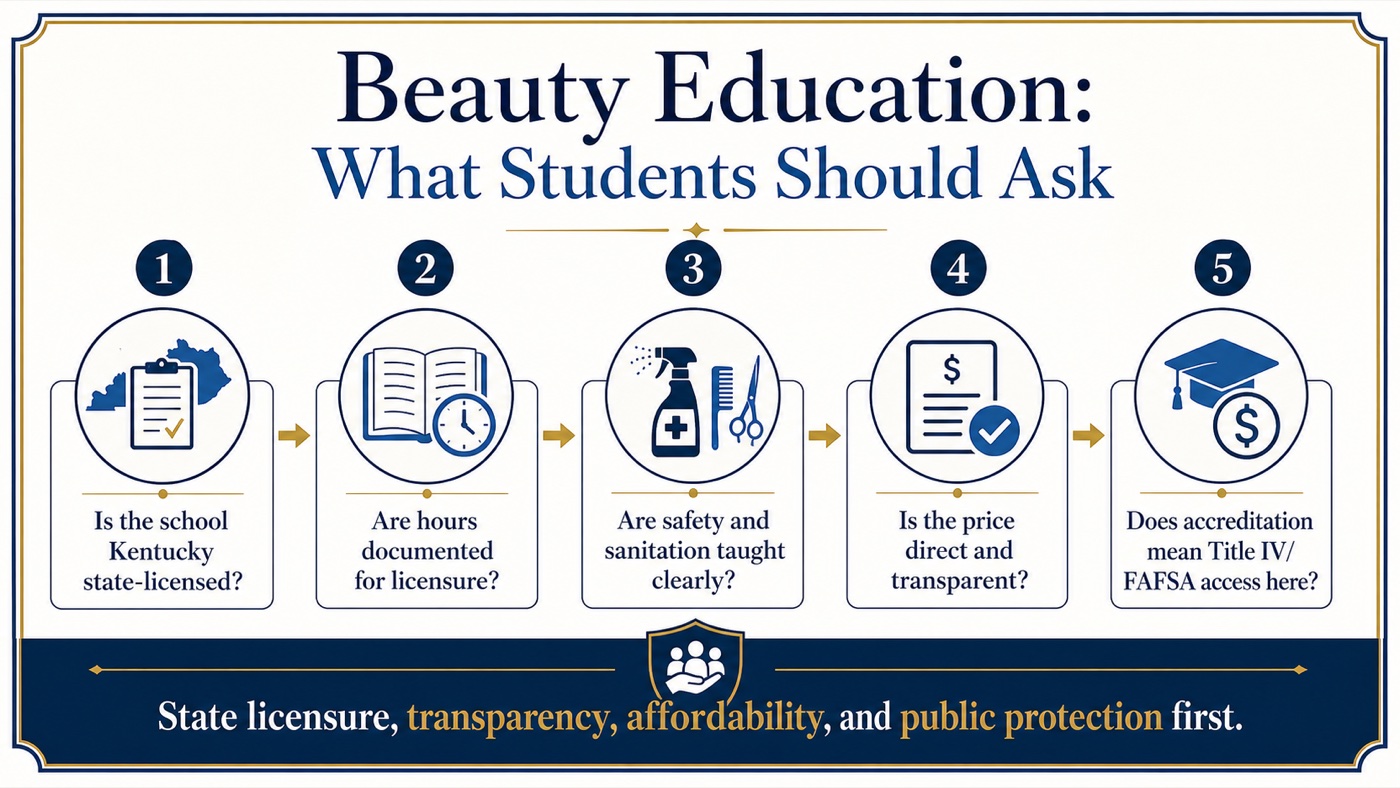
For nail and beauty education, students should ask clear questions about licensure, hours, sanitation, price, accreditation, and FAFSA access.
The question students should ask
When a student asks whether a beauty school is accredited, the clearer question may be: does the school use accreditation as a pathway to participate in Title IV/FAFSA federal student-aid programs?
That question does not replace the regulated basics. Students should still ask whether the school is state licensed, whether training hours are documented, whether safety and sanitation are taught clearly, whether the price is direct and transparent, and whether the program prepares eligible students for the licensure pathway.
Why US Nails is sharing it
The nail industry is not merely style. It is licensed work, public sanitation, small-business ownership, immigrant and working-family opportunity, and community trust. Clear public education protects students, salons, owners, families, and customers.
The LBA article is careful: it does not say NACCAS lost federal recognition; it says official records confirm unresolved recognition-compliance issues and that reported NACIQI voting remains advisory until ED issues the final decision.
Beauty education should be taught through law, regulation, safety, sanitation, affordability, transparency, and licensure readiness, not prestige language alone.
Nail salons are not just beauty businesses. They are one of America’s clearest public test cases for how state regulation, immigrant entrepreneurship, worker protection, sanitation, language access, and small-business survival meet in real life.
This article opens the USNails.net Nail Industry Center of Excellence series. The purpose is not to attack regulation. The purpose is to make regulation understandable, fair, documented, and human.
Published by USNails.net with research support from Di Tran University – College of Humanization Research.
Why Nail Salons Become The Test Case
Nail technology sits in a rare public position. A single salon can involve a state cosmetology board license, a salon inspection, sanitation rules, chemical-safety guidance, worker classification, payroll law, consumer trust, language access, and family entrepreneurship. That makes the nail industry one of the most important places to study whether public rules are clear, fair, and usable by real working people.
Many nail salons are also immigrant and Vietnamese American small businesses. That history matters. It does not make the industry above regulation. It means public education must be accurate, respectful, multilingual where possible, and careful about how enforcement, licensing, and compliance actually touch people’s lives.
The Four Legal Lanes Every Nail Professional Should Understand
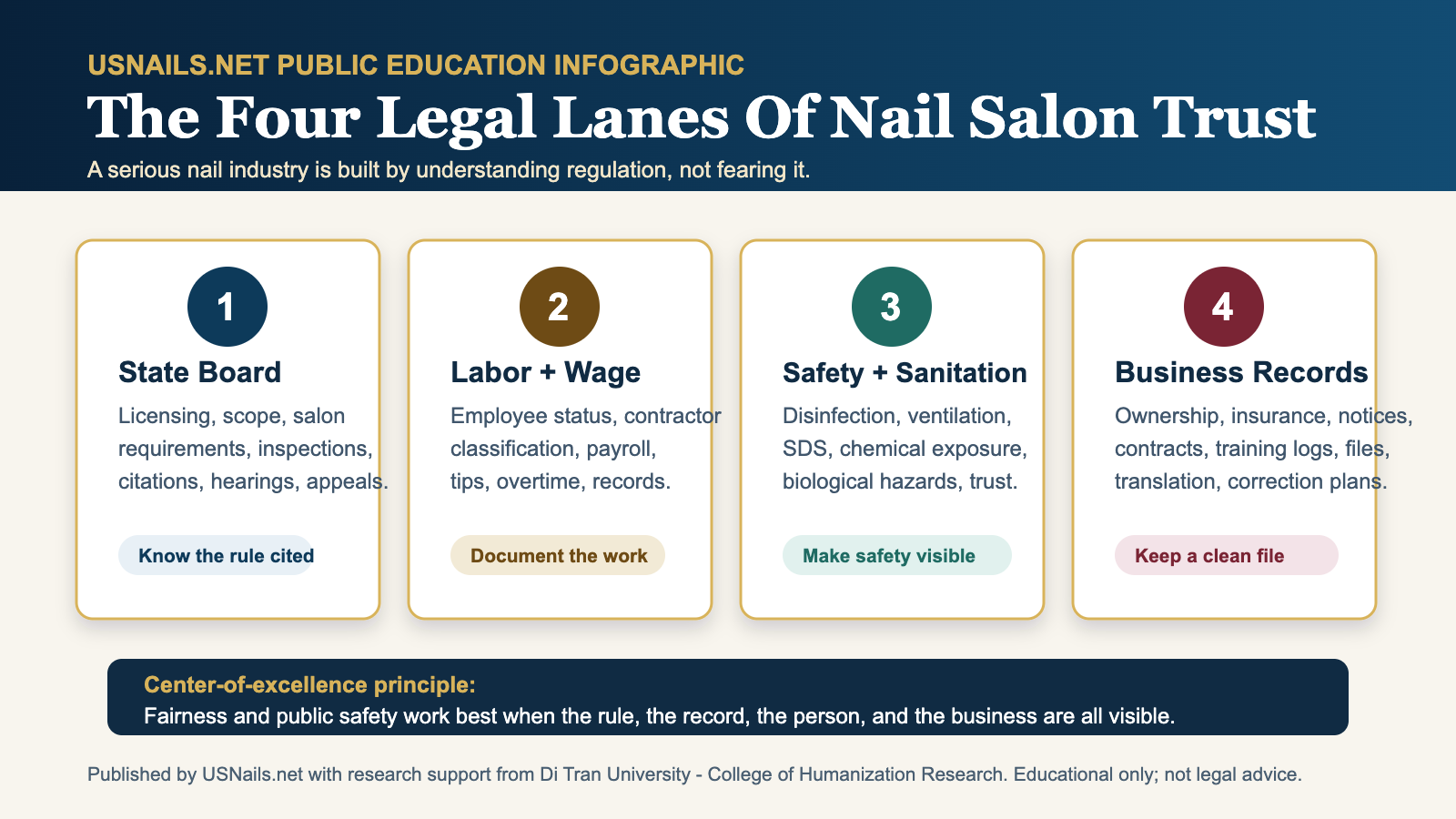
The modern nail industry cannot be understood through beauty trends alone. Four legal lanes shape the field every day:
State board regulation: licensing, scope of practice, salon requirements, inspections, citations, hearings, and discipline.
Labor and wage law: employee status, independent-contractor rules, booth or table rental, wage records, overtime, tips, and anti-retaliation rules.
Safety and sanitation: disinfection, ventilation, product safety, biological hazards, chemical exposure, safety data sheets, and public-health expectations.
Business and documentation: ownership records, tax and payroll systems, insurance, notices, contracts, multilingual training, and inspection files.
When one lane is misunderstood, the whole salon can suffer. When all four lanes are taught clearly, the industry becomes stronger.
Lawsuits, Legislation, Agency Guidance, And Research Are Not The Same
USNails.net will cover lawsuits and regulatory developments, but legal language must stay precise. A lawsuit is not automatically proof. A settlement is not automatically an admission. A court order is different from a news report. A statute is different from an agency FAQ. A research report is different from a legal ruling.
That distinction is not weakness. It is credibility. The nail industry deserves advocacy that is powerful enough to be useful and disciplined enough to be trusted.
The Cases And Sources This Series Will Study
The 50-day USNails.net series will study legal and regulatory examples such as the Nguyen litigation involving the Louisiana State Board of Cosmetology, the Amy Cao due-process and jury-trial challenge reported by legal advocacy organizations, California’s manicurist worker-classification debate and AB 1514, Kentucky Senate Bill 14, New York nail salon wage-bond and labor-protection history, OSHA and CDC/NIOSH nail salon safety guidance, and the documented history of Vietnamese American participation in the nail industry.
Each article will label the legal posture clearly: allegation, pretrial ruling, settlement, pending case, legislation, agency guidance, research, or final judgment. That is how public education becomes serious.
Fairness Does Not Mean Anti-Regulation
The nail industry needs fair treatment and strong public trust at the same time. Sanitation rules matter. Worker protection matters. Due process matters. Language access matters. Small-business survival matters. These values should not be forced to compete against each other.
A mature nail-industry platform must be able to say two things together: public safety is real, and regulatory fairness is real. When the industry understands both, it becomes more professional, more defensible, and more respected.
Why Vietnamese And Immigrant Entrepreneurship Belongs In The Record
The rise of Vietnamese American nail professionals is part of American economic history. Families built salons, supply relationships, training pathways, and community knowledge across generations. That story should be told with dignity, without stereotype and without erasing other communities that helped build the field.
USNails.net will treat that history as institutional knowledge: a record of work, adaptation, entrepreneurship, skill, sacrifice, and public contribution.
What USNails.net Will Publish Over The Next 50 Days
This article begins a 50-day public-education sequence on nail law, regulation, lawsuits, sanitation, worker dignity, state-board fairness, Vietnamese and immigrant entrepreneurship, nail technology, beauty supply ecosystems, and the future of professional nail education.
The goal is simple: make USNails.net a national reference point for the nail industry, where students, salon owners, workers, regulators, journalists, vendors, and families can learn from source-backed, legally careful, visually clear, and human-centered public education.
Educational Disclaimer
This article is for public education and general industry literacy only. It is not legal advice, does not create an attorney-client relationship, and should not be used as a substitute for advice from qualified legal, tax, labor, or regulatory professionals. Case status, laws, agency guidance, and court records can change. Readers should verify current sources before relying on any legal or compliance information.
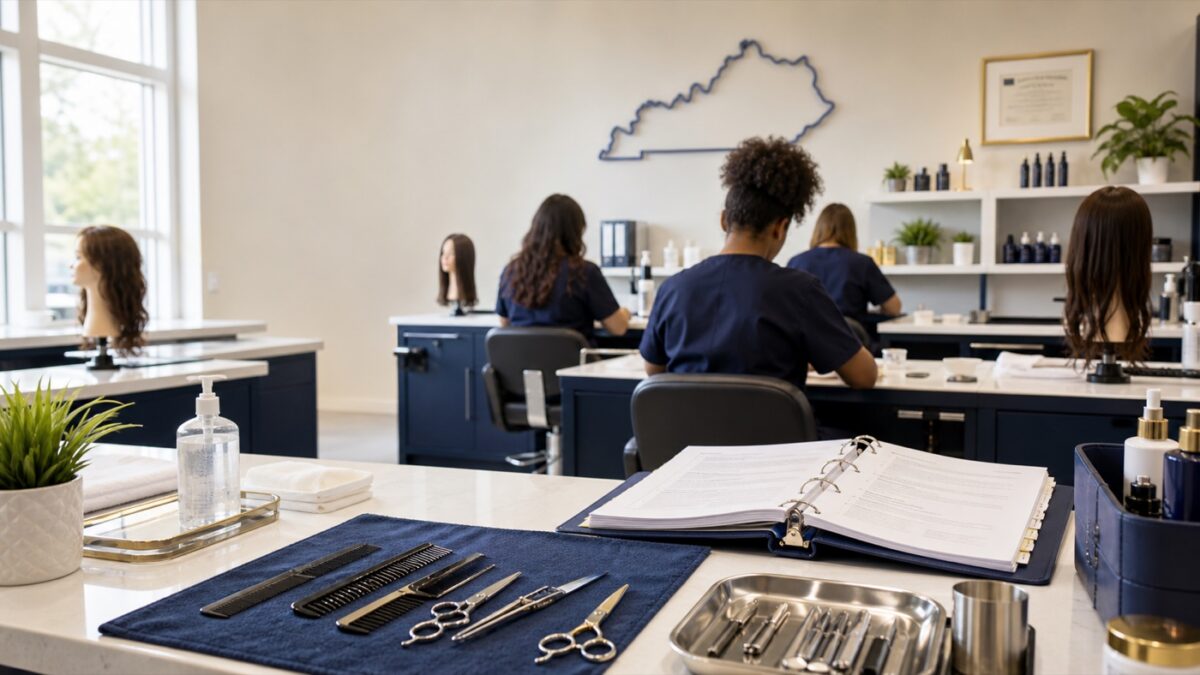
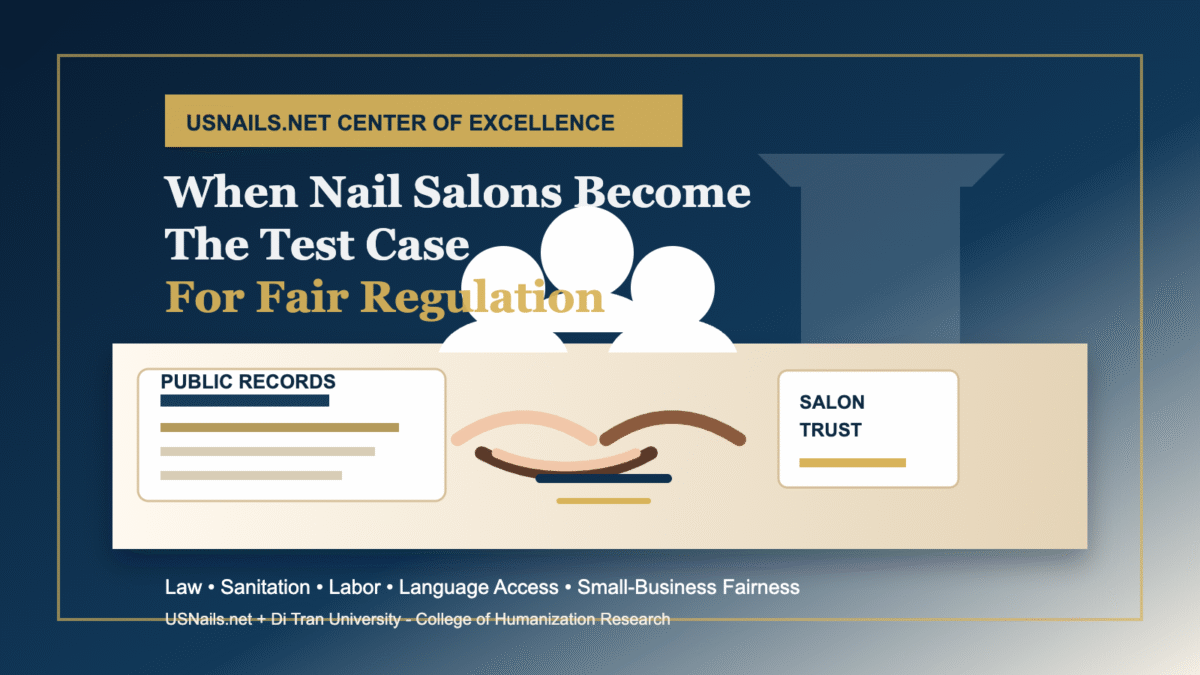
The featured image and infographic for this article were created as editorial educational visuals. They do not depict a specific real lawsuit, inspection, agency proceeding, private document, student record, or government endorsement.
The four legal lanes of nail salon trust: state board regulation, labor and wage law, safety and sanitation, and business records.
Educational note: This article is part of the US Nails industry-education series researched and supported by Di Tran University, the College of Humanization, and Louisville Beauty Academy. It is a general educational reflection, not a claim about every Vietnamese-owned salon or every nail professional.
The Nail Salon as an American Small-Business Pathway
Across the United States, nail salons have become more than beauty-service locations. For many immigrant families, including many Vietnamese American families, nail salons have represented a practical path into work, ownership, training, family support, and community presence. The story is not only about polish and design. It is about skill, resilience, entrepreneurship, language, licensing, customer trust, and the discipline required to serve the public every day.
Why This History Deserves Respect
Small salons often carry large responsibilities. Owners manage rent, staffing, sanitation, customer service, licensing, product costs, scheduling, reviews, family obligations, and constant public interaction. Workers must combine technical care with patience, posture, communication, and repeated service pressure. When done well, a salon becomes a place where economic mobility and human care meet.
Humanization in the Nail Industry
The future of the nail industry should not reduce technicians to labor or customers to transactions. A stronger future recognizes the human being on both sides of the table. The customer wants beauty, cleanliness, relaxation, and trust. The technician needs health, respect, fair standards, clear training, and a dignified workplace. A professional salon honors both.
From Family Business to Industry Education
US Nails preserves the local salon function while building an education layer for customers, students, workers, and owners. The purpose is simple: take the lived experience of salon work and translate it into public knowledge that helps the industry become safer, clearer, more respectful, and more trusted.
Educational note: This article is provided for public education by US Nails as part of an industry-education series researched and supported by Di Tran University, the College of Humanization, and Louisville Beauty Academy. It is not legal advice and does not replace the Kentucky Board of Cosmetology or current Kentucky law and regulation.
Licensing Literacy Protects the Public and the Worker
Nail technology is a licensed profession in Kentucky. Licensing is not just a government form. It is part of the public-trust structure that tells customers, employers, schools, and regulators that a person has followed the required training and examination path before providing regulated services.
The Kentucky Board of Cosmetology’s public license-requirements page lists nail technician requirements including 450 hours, grade 12 equivalency documentation, age requirement, successful written and practical examination, application for licensure, and license verification or license before providing services.
What Students Should Understand Early
Training hours must be documented carefully.
State requirements can change, so current official sources matter.
Exams and applications are separate steps from school attendance.
License verification matters before providing regulated services.
Out-of-state experience or licensure should be reviewed through official Kentucky pathways.
What Customers Should Understand
A customer does not need to know every regulation. But customers should understand that nail services are not casual work. They involve training, sanitation, product knowledge, and licensing duties. Respecting licensed work helps raise the standard for the entire industry.
What Salons Should Preserve
Salons should keep a culture of written clarity around licenses, permits, public notices, training expectations, sanitation routines, and service boundaries. If a question arises, written documentation and official-source literacy help the salon respond with accuracy rather than rumor.
Educational note: This article is provided for public education by US Nails as part of an industry-education series researched and supported by Di Tran University, the College of Humanization, and Louisville Beauty Academy. It is not legal advice and does not replace the Kentucky Board of Cosmetology or current Kentucky law and regulation.
Licensing Literacy Protects the Public and the Worker
Nail technology is a licensed profession in Kentucky. Licensing is not just a government form. It is part of the public-trust structure that tells customers, employers, schools, and regulators that a person has followed the required training and examination path before providing regulated services.
The Kentucky Board of Cosmetology’s public license-requirements page lists nail technician requirements including 450 hours, grade 12 equivalency documentation, age requirement, successful written and practical examination, application for licensure, and license verification or license before providing services.
What Students Should Understand Early
Training hours must be documented carefully.
State requirements can change, so current official sources matter.
Exams and applications are separate steps from school attendance.
License verification matters before providing regulated services.
Out-of-state experience or licensure should be reviewed through official Kentucky pathways.
What Customers Should Understand
A customer does not need to know every regulation. But customers should understand that nail services are not casual work. They involve training, sanitation, product knowledge, and licensing duties. Respecting licensed work helps raise the standard for the entire industry.
What Salons Should Preserve
Salons should keep a culture of written clarity around licenses, permits, public notices, training expectations, sanitation routines, and service boundaries. If a question arises, written documentation and official-source literacy help the salon respond with accuracy rather than rumor.
Educational note: This article is part of the US Nails industry-education series researched and supported by Di Tran University, the College of Humanization, and Louisville Beauty Academy. It is a general educational reflection, not a claim about every Vietnamese-owned salon or every nail professional.
The Nail Salon as an American Small-Business Pathway
Across the United States, nail salons have become more than beauty-service locations. For many immigrant families, including many Vietnamese American families, nail salons have represented a practical path into work, ownership, training, family support, and community presence. The story is not only about polish and design. It is about skill, resilience, entrepreneurship, language, licensing, customer trust, and the discipline required to serve the public every day.
Why This History Deserves Respect
Small salons often carry large responsibilities. Owners manage rent, staffing, sanitation, customer service, licensing, product costs, scheduling, reviews, family obligations, and constant public interaction. Workers must combine technical care with patience, posture, communication, and repeated service pressure. When done well, a salon becomes a place where economic mobility and human care meet.
Humanization in the Nail Industry
The future of the nail industry should not reduce technicians to labor or customers to transactions. A stronger future recognizes the human being on both sides of the table. The customer wants beauty, cleanliness, relaxation, and trust. The technician needs health, respect, fair standards, clear training, and a dignified workplace. A professional salon honors both.
From Family Business to Industry Education
US Nails preserves the local salon function while building an education layer for customers, students, workers, and owners. The purpose is simple: take the lived experience of salon work and translate it into public knowledge that helps the industry become safer, clearer, more respectful, and more trusted.
Educational note: This article is provided for public education by US Nails as part of an industry-education series researched and supported by Di Tran University, the College of Humanization, and Louisville Beauty Academy. It is not legal, accounting, regulatory, or employment advice.
Documentation Is How Professionalism Becomes Visible
A nail salon can be friendly, talented, and hardworking, but if important standards exist only in memory, the business becomes fragile. Documentation turns good habits into repeatable systems. It helps owners train staff, helps workers understand expectations, helps customers trust the environment, and helps the salon respond calmly when questions arise.
What a Salon Should Be Able to Explain
How tools are cleaned, disinfected, stored, or treated as single-use.
Which products are used for common services and where product directions are available.
How the salon handles ventilation, odor control, and covered waste.
How licenses, permits, and required public notices are maintained.
How customer complaints or concerns are received and resolved.
How staff learn the salon’s safety and sanitation routines.
Documentation Does Not Need to Be Complicated
The best starting point is a simple binder or digital folder: sanitation routine, product list, license/permit references, training checklist, customer concern log, and source links to current public rules. The value is not paperwork for its own sake. The value is clarity when people are busy, tired, new, or under pressure.
Why This Matters for the Public
Customers cannot see every behind-the-scenes practice. They can see whether the salon feels organized, whether staff answer questions respectfully, whether tools and spaces appear clean, and whether licenses and public information are treated seriously. Documentation supports that visible trust.
Educational note: This article is part of the US Nails industry-education series researched and supported by Di Tran University, the College of Humanization, and Louisville Beauty Academy. It is not medical, engineering, OSHA-compliance, or legal advice.
Ventilation Is a Professional Standard
Nail salons are places of beauty, service, and skilled work. They are also chemical-use workplaces. That means air quality matters. Ventilation is not only about odor. It is about reducing repeated exposure, supporting worker health, and making the salon feel more professional for customers and staff.
NIOSH notes that nail technicians can face chemical, ergonomic, and other workplace hazards, and that ventilation and gloves can help reduce chemical exposure. A strong salon treats this as part of daily professional practice rather than a complaint-driven afterthought.
Good Air Practice Starts With Simple Habits
Keep product containers closed when they are not actively being used.
Use only the amount of product needed for the service.
Place trash with product residue into covered containers when appropriate.
Avoid placing open chemical containers directly near the breathing zone.
Maintain fresh air and local exhaust practices where available.
Train staff to recognize when strong odor may signal poor control, not just normal salon activity.
Ventilation and Respect
Air quality is also a respect issue. Customers may notice odor for one visit; workers may experience exposure throughout the workweek. A salon that pays attention to air, posture, breaks, gloves, product storage, and cleaning routines is communicating that worker dignity and customer care belong together.
What Customers Can Ask
Customers can ask simple, respectful questions: Is there ventilation in the salon? Are containers kept closed when not in use? Are strong-smelling products handled carefully? The goal is not to embarrass a technician. The goal is to support a culture where health, cleanliness, and professional care are normal.
Educational note: This article is provided for public education by US Nails as part of an industry-education series researched and supported by Di Tran University, the College of Humanization, and Louisville Beauty Academy. It is not medical, legal, or regulatory advice.
Why Nail Product Literacy Matters
Modern nail care is built on professional skill, product knowledge, sanitation discipline, and honest communication. A nail product is not automatically unsafe because it contains a chemical ingredient, and it is not automatically safe because a label uses words like natural, clean, non-toxic, free, or professional. The better standard is literacy: know the product, read the label, follow the directions, maintain ventilation, and use products only within the scope of training and licensure.
The U.S. Food and Drug Administration explains that nail products sold in the United States must be safe for consumers when used as directed or in the usual customary way. That does not remove the need for care. Many nail products can contain ingredients that require proper use, good ventilation, careful storage, and professional judgment.
A Practical Product Literacy Checklist
Read the label: product name, intended use, warnings, directions, and manufacturer instructions matter.
Use the right product for the right service: polish, gel, acrylic, adhesive, remover, primer, and disinfectant are not interchangeable.
Respect exposure: repeated workplace exposure is different from occasional consumer exposure.
Keep containers closed: open containers can increase vapors and waste product.
Ventilate the work area: air movement and source control are worker-health practices, not decoration.
Document product systems: salons should know what brands and product lines are being used in routine services.
For Customers
A customer does not need to become a chemist before receiving a manicure. But customers can ask respectful questions: What product is being used? Is it appropriate for this service? Is the workspace clean and ventilated? Are tools disinfected or single-use where required? Professional salons should welcome reasonable questions because written clarity and visible care build trust.
For Nail Professionals
Product literacy protects the technician, the customer, and the salon. Nail professionals work with products repeatedly throughout the day. That makes training, ventilation, gloves when appropriate, posture, breaks, safe storage, and written procedures part of the professional standard. The strongest salons do not rely on memory alone; they build routines that a trained team can follow.
Customers should feel comfortable asking basic safety and service questions before receiving nail care. A serious salon should welcome respectful questions because clarity builds trust.
Questions customers may ask
Is the salon licensed and operating under current state rules?
Licensing rules vary by state. Customers do not need to become regulators, but they may reasonably expect a salon to understand its licensing obligations and display or provide required information where the rules require it.
How are tools and surfaces cleaned between clients?
This question matters because nail care involves close contact with hands, feet, skin, tools, and shared surfaces. A professional answer should be calm, clear, and consistent.
What product is being used?
Customers may ask what type of product is being used, whether it has specific warnings, and how it should be maintained after the service. Professionals should avoid vague answers when product identity matters.
What should I do if I notice discomfort, irritation, or a problem after the service?
A responsible salon should take concerns seriously, avoid medical diagnosis unless properly licensed to do so, and encourage appropriate medical care when health symptoms require it.
Respect works both ways
Customers deserve cleanliness, clarity, and respectful service. Nail professionals also deserve dignity, patience, fair treatment, and a workplace that protects their health. The strongest salons build trust in both directions.
The US Nails education position
This article is part of a public education series provided, sponsored, and researched by Di Tran University, the College of Humanization, and Louisville Beauty Academy. The goal is simple: better questions, better documentation, safer salons, and more respect for the people who do the work.
Educational limit: This article is public education, not legal advice, medical advice, or a substitute for current state-board rules. Nail professionals and salon owners should verify requirements directly with their licensing board and applicable local authorities.