Categories
Nail Industry Education

Accreditation, FAFSA, and Beauty Education: What Nail and Beauty Students Should Understand

Industry education update. Nail and beauty professionals deserve plain-English teaching on accreditation, FAFSA, state licensure, safety, sanitation, and public trust.

Louisville Beauty Academy has published a source-backed public update on the July 2026 federal review of NACCAS and the practical meaning of accreditation in beauty education.
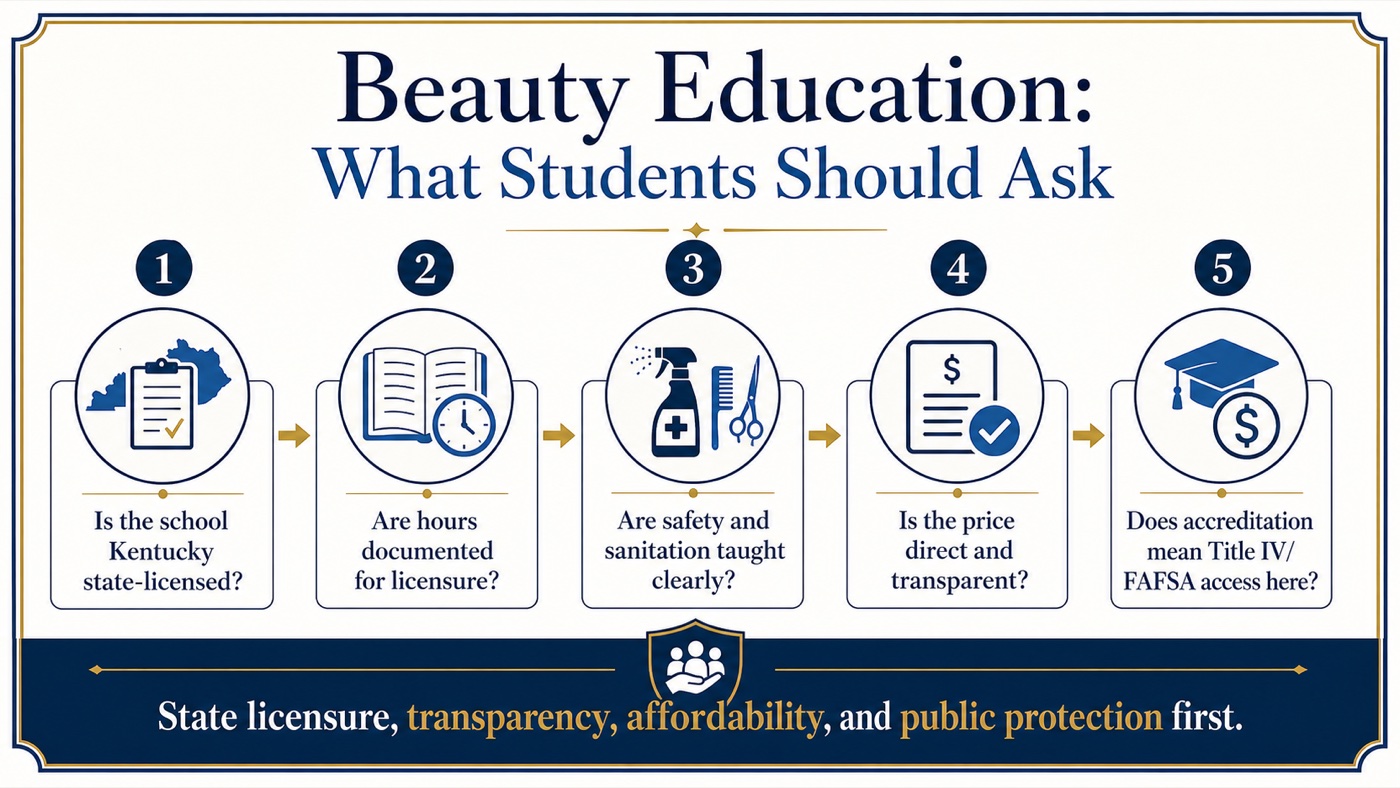
Infographic asking whether a beauty school is state licensed, documents hours, teaches sanitation, has transparent pricing, and uses accreditation for FAFSA access.
For nail and beauty education, students should ask clear questions about licensure, hours, sanitation, price, accreditation, and FAFSA access.

The question students should ask

When a student asks whether a beauty school is accredited, the clearer question may be: does the school use accreditation as a pathway to participate in Title IV/FAFSA federal student-aid programs?

That question does not replace the regulated basics. Students should still ask whether the school is state licensed, whether training hours are documented, whether safety and sanitation are taught clearly, whether the price is direct and transparent, and whether the program prepares eligible students for the licensure pathway.

Why US Nails is sharing it

The nail industry is not merely style. It is licensed work, public sanitation, small-business ownership, immigrant and working-family opportunity, and community trust. Clear public education protects students, salons, owners, families, and customers.

The LBA article is careful: it does not say NACCAS lost federal recognition; it says official records confirm unresolved recognition-compliance issues and that reported NACIQI voting remains advisory until ED issues the final decision.

Beauty education should be taught through law, regulation, safety, sanitation, affordability, transparency, and licensure readiness, not prestige language alone.

Sources and Public Reference

Categories
Nail Industry Education

Nail Salon Documentation: How Written Standards Protect Customers, Workers, and Owners

Educational note: This article is provided for public education by US Nails as part of an industry-education series researched and supported by Di Tran University, the College of Humanization, and Louisville Beauty Academy. It is not legal, accounting, regulatory, or employment advice.

Documentation Is How Professionalism Becomes Visible

A nail salon can be friendly, talented, and hardworking, but if important standards exist only in memory, the business becomes fragile. Documentation turns good habits into repeatable systems. It helps owners train staff, helps workers understand expectations, helps customers trust the environment, and helps the salon respond calmly when questions arise.

What a Salon Should Be Able to Explain

  • How tools are cleaned, disinfected, stored, or treated as single-use.
  • Which products are used for common services and where product directions are available.
  • How the salon handles ventilation, odor control, and covered waste.
  • How licenses, permits, and required public notices are maintained.
  • How customer complaints or concerns are received and resolved.
  • How staff learn the salon’s safety and sanitation routines.

Documentation Does Not Need to Be Complicated

The best starting point is a simple binder or digital folder: sanitation routine, product list, license/permit references, training checklist, customer concern log, and source links to current public rules. The value is not paperwork for its own sake. The value is clarity when people are busy, tired, new, or under pressure.

Why This Matters for the Public

Customers cannot see every behind-the-scenes practice. They can see whether the salon feels organized, whether staff answer questions respectfully, whether tools and spaces appear clean, and whether licenses and public information are treated seriously. Documentation supports that visible trust.

Sources and Reference Points

Related reading: Nail Salon Professional Standards.

Categories
Nail Industry Education

Nail Salon Ventilation and Worker Health: Why Air Quality Is Part of Professional Care

Educational note: This article is part of the US Nails industry-education series researched and supported by Di Tran University, the College of Humanization, and Louisville Beauty Academy. It is not medical, engineering, OSHA-compliance, or legal advice.

Ventilation Is a Professional Standard

Nail salons are places of beauty, service, and skilled work. They are also chemical-use workplaces. That means air quality matters. Ventilation is not only about odor. It is about reducing repeated exposure, supporting worker health, and making the salon feel more professional for customers and staff.

NIOSH notes that nail technicians can face chemical, ergonomic, and other workplace hazards, and that ventilation and gloves can help reduce chemical exposure. A strong salon treats this as part of daily professional practice rather than a complaint-driven afterthought.

Good Air Practice Starts With Simple Habits

  • Keep product containers closed when they are not actively being used.
  • Use only the amount of product needed for the service.
  • Place trash with product residue into covered containers when appropriate.
  • Avoid placing open chemical containers directly near the breathing zone.
  • Maintain fresh air and local exhaust practices where available.
  • Train staff to recognize when strong odor may signal poor control, not just normal salon activity.

Ventilation and Respect

Air quality is also a respect issue. Customers may notice odor for one visit; workers may experience exposure throughout the workweek. A salon that pays attention to air, posture, breaks, gloves, product storage, and cleaning routines is communicating that worker dignity and customer care belong together.

What Customers Can Ask

Customers can ask simple, respectful questions: Is there ventilation in the salon? Are containers kept closed when not in use? Are strong-smelling products handled carefully? The goal is not to embarrass a technician. The goal is to support a culture where health, cleanliness, and professional care are normal.

Sources and Reference Points

Related reading: Nail Salon Safety, Sanitation, and Worker Health.

Categories
Nail Industry Education

Nail Product Literacy: Labels, Ingredients, Safety Directions, and Professional Trust

Educational note: This article is provided for public education by US Nails as part of an industry-education series researched and supported by Di Tran University, the College of Humanization, and Louisville Beauty Academy. It is not medical, legal, or regulatory advice.

Why Nail Product Literacy Matters

Modern nail care is built on professional skill, product knowledge, sanitation discipline, and honest communication. A nail product is not automatically unsafe because it contains a chemical ingredient, and it is not automatically safe because a label uses words like natural, clean, non-toxic, free, or professional. The better standard is literacy: know the product, read the label, follow the directions, maintain ventilation, and use products only within the scope of training and licensure.

The U.S. Food and Drug Administration explains that nail products sold in the United States must be safe for consumers when used as directed or in the usual customary way. That does not remove the need for care. Many nail products can contain ingredients that require proper use, good ventilation, careful storage, and professional judgment.

A Practical Product Literacy Checklist

  • Read the label: product name, intended use, warnings, directions, and manufacturer instructions matter.
  • Use the right product for the right service: polish, gel, acrylic, adhesive, remover, primer, and disinfectant are not interchangeable.
  • Respect exposure: repeated workplace exposure is different from occasional consumer exposure.
  • Keep containers closed: open containers can increase vapors and waste product.
  • Ventilate the work area: air movement and source control are worker-health practices, not decoration.
  • Document product systems: salons should know what brands and product lines are being used in routine services.

For Customers

A customer does not need to become a chemist before receiving a manicure. But customers can ask respectful questions: What product is being used? Is it appropriate for this service? Is the workspace clean and ventilated? Are tools disinfected or single-use where required? Professional salons should welcome reasonable questions because written clarity and visible care build trust.

For Nail Professionals

Product literacy protects the technician, the customer, and the salon. Nail professionals work with products repeatedly throughout the day. That makes training, ventilation, gloves when appropriate, posture, breaks, safe storage, and written procedures part of the professional standard. The strongest salons do not rely on memory alone; they build routines that a trained team can follow.

Sources and Reference Points

Related reading: US Nails Industry Education Hub and US Nails Louisville locations.

Categories
Nail Industry Education

What Customers Should Ask Before a Nail Service: Safety, Cleanliness, Product Awareness, and Respect

A good customer question is not disrespect

Customers should feel comfortable asking basic safety and service questions before receiving nail care. A serious salon should welcome respectful questions because clarity builds trust.

Questions customers may ask

Is the salon licensed and operating under current state rules?

Licensing rules vary by state. Customers do not need to become regulators, but they may reasonably expect a salon to understand its licensing obligations and display or provide required information where the rules require it.

How are tools and surfaces cleaned between clients?

This question matters because nail care involves close contact with hands, feet, skin, tools, and shared surfaces. A professional answer should be calm, clear, and consistent.

What product is being used?

Customers may ask what type of product is being used, whether it has specific warnings, and how it should be maintained after the service. Professionals should avoid vague answers when product identity matters.

What should I do if I notice discomfort, irritation, or a problem after the service?

A responsible salon should take concerns seriously, avoid medical diagnosis unless properly licensed to do so, and encourage appropriate medical care when health symptoms require it.

Respect works both ways

Customers deserve cleanliness, clarity, and respectful service. Nail professionals also deserve dignity, patience, fair treatment, and a workplace that protects their health. The strongest salons build trust in both directions.

The US Nails education position

This article is part of a public education series provided, sponsored, and researched by Di Tran University, the College of Humanization, and Louisville Beauty Academy. The goal is simple: better questions, better documentation, safer salons, and more respect for the people who do the work.

Educational limit: This article is public education, not legal advice, medical advice, or a substitute for current state-board rules. Nail professionals and salon owners should verify requirements directly with their licensing board and applicable local authorities.

Reference Sources

Categories
Nail Industry Education

Nail Salon Professional Standards: Licensing, Sanitation, Product Safety, Worker Health, and Documentation

Why professional standards matter

A nail salon is not only a place of beauty. It is a licensed service environment where trust is created through training, sanitation, product awareness, worker protection, and written discipline.

US Nails treats professional nail care as a serious field of human service. A clean table, a current license, a properly labeled product, a ventilated workspace, and a respectful technician are not small details. They are the public evidence of care.

The six-part standard

1. Licensing

Licensing helps the public know that a person or salon is operating inside a state-recognized professional framework. Requirements differ by state, so students, workers, and owners should always read the current rule from the relevant board.

2. Sanitation

Sanitation is the discipline of preventing avoidable harm. Tools, surfaces, pedicure systems, towels, and work areas should be handled through consistent written procedures, not memory or habit alone.

3. Product Safety

Nail products should be labeled, stored, ventilated, and used according to directions and warnings. Product knowledge is part of professional respect for both the customer and the worker.

4. Ventilation

Ventilation matters because nail professionals work near dust, vapors, and repeated product exposure. A salon should treat air quality as an operational responsibility, not an afterthought.

5. Worker Health

Professionalism includes the health of the person providing the service. Posture, repetitive motion, skin exposure, respiratory awareness, breaks, and reporting concerns belong inside the salon’s standard of care.

6. Documentation

When a salon documents licenses, sanitation routines, product information, training, incidents, and inspection readiness, it protects customers, workers, owners, and the profession itself.

The US Nails education position

This public series is provided, sponsored, and researched by Di Tran University, the College of Humanization, and Louisville Beauty Academy to elevate nail care as licensed, documented, human-centered professional work.

Educational limit: This article is public education, not legal advice, medical advice, or a substitute for current state-board rules. Nail professionals and salon owners should verify requirements directly with their licensing board and applicable local authorities.

Reference Sources

Categories
Nail Industry Education

Nail Salon Safety, Sanitation, and Worker Health: A Professional Standards Guide

Safety, Sanitation, and Worker Health
Nail Salon Safety, Sanitation, and Worker Health: A Professional Standards Guide

A beautiful nail service is not complete unless the environment respects sanitation, product safety, client trust, and the health of the workers providing the service.

Provided, sponsored, and researched by Di Tran University, the College of Humanization, and Louisville Beauty Academy.
Part of the US Nails Industry Education Hub. Public education only; verify current rules with the proper licensing board or official agency.

Safety is part of beauty

Nail salons use products, implements, water systems, workstations, dust, and repeated close-contact service. That means safety is not an optional back-room topic. It belongs inside the professional identity of the salon. Clients should see cleanliness. Workers should feel protected. Owners should build systems that make safe practice routine rather than dependent on memory.

The most serious salons treat sanitation, ventilation, labeling, and worker health as business infrastructure. That does not make the salon cold or clinical. It makes the care more trustworthy.

Professional standard areas

Sanitation

Tools, surfaces, pedicure equipment, linens, and shared implements require consistent cleaning, disinfection, storage, and disposal discipline.

Product awareness

Nail products should be labeled, stored, ventilated, and used according to directions and warnings. Workers should understand exposure routes.

Worker dignity

Ventilation, masks when appropriate, posture, breaks, glove practices, and ergonomic setup protect the people doing the labor.

A salon-owner checklist

  • Use current state-board sanitation and salon requirements as the controlling rule path.
  • Keep products labeled and avoid mystery containers.
  • Maintain ventilation and reduce avoidable dust or vapor exposure.
  • Train workers on chemical warnings and safe product use.
  • Document cleaning routines and make standards visible enough for staff to follow.
  • Teach customers that professional care may include saying no when a service appears unsafe or inappropriate.
Professional dignity principle: the nail worker is not a tool for beauty. The worker is a human being whose health, lungs, posture, hands, and judgment matter.

References and official source path

Editorial standard

US Nails publishes this series to raise the standard of public nail-industry education: clear enough for customers, serious enough for professionals, and careful enough for students and salon owners who must respect real licensing and safety obligations.

Categories
Nail Industry Education

State Licensing of Nail Technology: What Students, Salons, and the Public Should Understand

Licensing and Regulation
State Licensing of Nail Technology: What Students, Salons, and the Public Should Understand

In the United States, nail technology is not governed by one single national salon license. States control licensing, exams, salon approvals, inspections, and many practice rules.

Provided, sponsored, and researched by Di Tran University, the College of Humanization, and Louisville Beauty Academy.
Part of the US Nails Industry Education Hub. Public education only; verify current rules with the proper licensing board or official agency.

The first rule: check the state board

Nail technology licensing is primarily state-based. A person trained or licensed in one state should not assume that another state has the same hour requirement, exam pathway, salon license rule, reciprocity process, renewal requirement, or sanitation standard. The serious professional habit is simple: find the official board, read the current rule, keep written proof, and ask the board or school for clarification before relying on rumor.

Kentucky routes cosmetology and nail-related regulatory information through the Kentucky Board of Cosmetology. That official path matters more than screenshots, social posts, old school handouts, or verbal statements that may have become stale.

What licensing is meant to protect

The public

Licensing and inspections help protect customers from unsafe, unsanitary, or unqualified practice.

The student

Written rules help students understand training, examinations, applications, permits, renewals, and lawful scope.

The profession

Licensing gives serious practitioners a recognized path and helps separate professional practice from casual work.

How to read a licensing requirement

  • Identify the exact license type: nail technician, cosmetologist, esthetician, salon, school, instructor, or manager.
  • Confirm the current source: state-board website, statute, administrative regulation, application form, or official exam bulletin.
  • Separate school training from exam eligibility, exam passage from licensure, and licensure from salon operation.
  • Check whether the issue is about a person, a salon, a school, a location, a manager, or a change of ownership.
  • Keep dated copies of important written guidance, because rules and forms can change.
No shortcut doctrine: professional confidence comes from written clarity, not hallway rumor. If it affects a license, a salon, money, or a student decision, verify it in writing.

References and official source path

Editorial standard

US Nails publishes this series to raise the standard of public nail-industry education: clear enough for customers, serious enough for professionals, and careful enough for students and salon owners who must respect real licensing and safety obligations.

Categories
Nail Industry Education

The History of Nails: From Human Care to Modern Nail Technology

History of Nails
The History of Nails: From Human Care to Modern Nail Technology

Nails are not a small subject. They sit where personal grooming, health awareness, artistry, class, gender, migration, commerce, chemistry, and professional licensing meet.

Provided, sponsored, and researched by Di Tran University, the College of Humanization, and Louisville Beauty Academy.
Part of the US Nails Industry Education Hub. Public education only; verify current rules with the proper licensing board or official agency.

Why nail history matters

Nail care is one of the oldest forms of visible human self-presentation. Before it became a modern salon service, the condition, color, length, and treatment of nails carried meanings tied to cleanliness, beauty, class, ceremony, labor, and personal identity. A serious nail-industry history does not treat nails as decoration only. It treats them as a human practice: people care for their hands and feet because hands work, hands touch, hands serve, hands greet, and hands are seen.

Modern nail salons inherited that human history and added professional technique: manicure, pedicure, polish, acrylic, gel, dip systems, sanitation protocols, product chemistry, customer service, and licensing duties. The profession deserves to be taught with dignity because it combines beauty, health-adjacent caution, detailed hand skill, and daily service to real people.

A practical timeline for the nail profession

Adornment

Across cultures, nail color and hand care developed as visible signs of identity, beauty, status, and social presentation.

Professionalization

Beauty services became organized into schools, salons, licenses, inspections, rules, and professional expectations.

Technology

Modern nail systems introduced new products and methods, making chemistry, ventilation, labeling, and worker education more important.

From beauty service to public trust

A nail professional works close to the client. That closeness creates trust but also responsibility. The professional must understand cleanliness, implements, skin and nail caution, product use, and boundaries. That is why public education matters. Customers should know that a low price is not the same as professional quality, and professionals should know that art is strongest when backed by discipline.

Humanization principle: the best nail history honors both the customer who wants beauty and the worker whose hands, lungs, posture, and dignity must also be protected.

References and official source path

Editorial standard

US Nails publishes this series to raise the standard of public nail-industry education: clear enough for customers, serious enough for professionals, and careful enough for students and salon owners who must respect real licensing and safety obligations.