Nail salons are not just beauty businesses. They are one of America’s clearest public test cases for how state regulation, immigrant entrepreneurship, worker protection, sanitation, language access, and small-business survival meet in real life.
This article opens the USNails.net Nail Industry Center of Excellence series. The purpose is not to attack regulation. The purpose is to make regulation understandable, fair, documented, and human.
Published by USNails.net with research support from Di Tran University – College of Humanization Research.
Why Nail Salons Become The Test Case
Nail technology sits in a rare public position. A single salon can involve a state cosmetology board license, a salon inspection, sanitation rules, chemical-safety guidance, worker classification, payroll law, consumer trust, language access, and family entrepreneurship. That makes the nail industry one of the most important places to study whether public rules are clear, fair, and usable by real working people.
Many nail salons are also immigrant and Vietnamese American small businesses. That history matters. It does not make the industry above regulation. It means public education must be accurate, respectful, multilingual where possible, and careful about how enforcement, licensing, and compliance actually touch people’s lives.
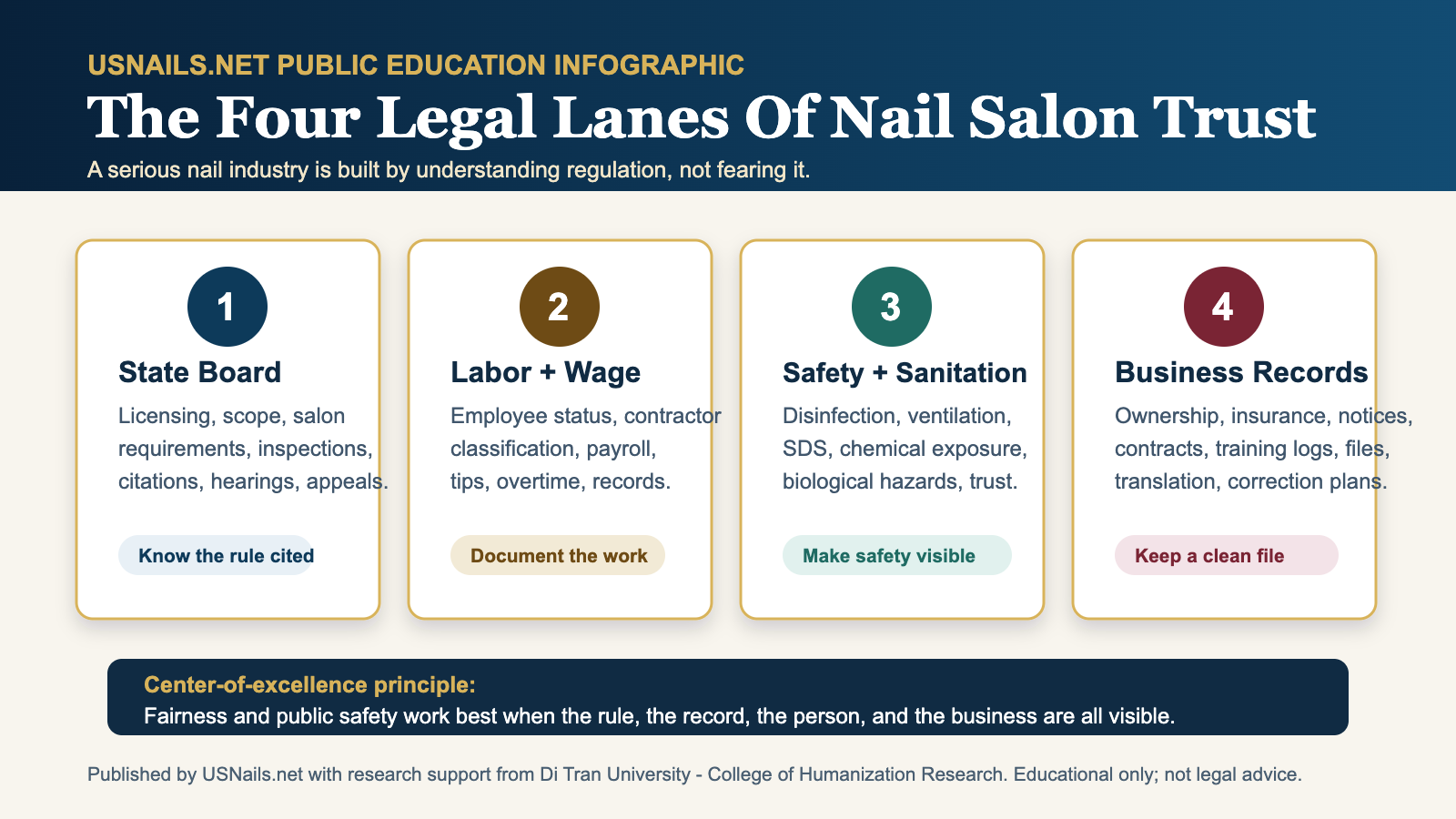
The Four Legal Lanes Every Nail Professional Should Understand
The modern nail industry cannot be understood through beauty trends alone. Four legal lanes shape the field every day:
- State board regulation: licensing, scope of practice, salon requirements, inspections, citations, hearings, and discipline.
- Labor and wage law: employee status, independent-contractor rules, booth or table rental, wage records, overtime, tips, and anti-retaliation rules.
- Safety and sanitation: disinfection, ventilation, product safety, biological hazards, chemical exposure, safety data sheets, and public-health expectations.
- Business and documentation: ownership records, tax and payroll systems, insurance, notices, contracts, multilingual training, and inspection files.
When one lane is misunderstood, the whole salon can suffer. When all four lanes are taught clearly, the industry becomes stronger.
Lawsuits, Legislation, Agency Guidance, And Research Are Not The Same
USNails.net will cover lawsuits and regulatory developments, but legal language must stay precise. A lawsuit is not automatically proof. A settlement is not automatically an admission. A court order is different from a news report. A statute is different from an agency FAQ. A research report is different from a legal ruling.
That distinction is not weakness. It is credibility. The nail industry deserves advocacy that is powerful enough to be useful and disciplined enough to be trusted.
The Cases And Sources This Series Will Study
The 50-day USNails.net series will study legal and regulatory examples such as the Nguyen litigation involving the Louisiana State Board of Cosmetology, the Amy Cao due-process and jury-trial challenge reported by legal advocacy organizations, California’s manicurist worker-classification debate and AB 1514, Kentucky Senate Bill 14, New York nail salon wage-bond and labor-protection history, OSHA and CDC/NIOSH nail salon safety guidance, and the documented history of Vietnamese American participation in the nail industry.
Each article will label the legal posture clearly: allegation, pretrial ruling, settlement, pending case, legislation, agency guidance, research, or final judgment. That is how public education becomes serious.
Fairness Does Not Mean Anti-Regulation
The nail industry needs fair treatment and strong public trust at the same time. Sanitation rules matter. Worker protection matters. Due process matters. Language access matters. Small-business survival matters. These values should not be forced to compete against each other.
A mature nail-industry platform must be able to say two things together: public safety is real, and regulatory fairness is real. When the industry understands both, it becomes more professional, more defensible, and more respected.
Why Vietnamese And Immigrant Entrepreneurship Belongs In The Record
The rise of Vietnamese American nail professionals is part of American economic history. Families built salons, supply relationships, training pathways, and community knowledge across generations. That story should be told with dignity, without stereotype and without erasing other communities that helped build the field.
USNails.net will treat that history as institutional knowledge: a record of work, adaptation, entrepreneurship, skill, sacrifice, and public contribution.
What USNails.net Will Publish Over The Next 50 Days
This article begins a 50-day public-education sequence on nail law, regulation, lawsuits, sanitation, worker dignity, state-board fairness, Vietnamese and immigrant entrepreneurship, nail technology, beauty supply ecosystems, and the future of professional nail education.
The goal is simple: make USNails.net a national reference point for the nail industry, where students, salon owners, workers, regulators, journalists, vendors, and families can learn from source-backed, legally careful, visually clear, and human-centered public education.
Educational Disclaimer
This article is for public education and general industry literacy only. It is not legal advice, does not create an attorney-client relationship, and should not be used as a substitute for advice from qualified legal, tax, labor, or regulatory professionals. Case status, laws, agency guidance, and court records can change. Readers should verify current sources before relying on any legal or compliance information.
References And Public Sources
- Nguyen v. Louisiana State Board of Cosmetology, federal court record via Justia
- VOA/AP reporting on Louisiana nail salon settlement
- Pacific Legal Foundation: Amy Cao et al. v. Louisiana State Board of Cosmetology
- California Department of Industrial Relations: Licensed Manicurists FAQ
- California AB 1514 bill information
- OSHA: Health Hazards in Nail Salons
- CDC/NIOSH: Nail Technicians Workplace Safety and Health
- UCLA Labor Center: Nail Files research project
- Smithsonian: Vietnamese refugee history and the nail industry
Image Provenance
The featured image and infographic for this article were created as editorial educational visuals. They do not depict a specific real lawsuit, inspection, agency proceeding, private document, student record, or government endorsement.