
Categories
Nail Safety and Sanitation

Container, Tool, Contact, Leftover, Reset: A Product-Dispensing Evidence Card

Direct sources. Clear status. Practical public information.

Reviewed November 6, 2026 · Kentucky · current 201 KAR 12:100, Sections 11–12. Product dispensing is a contamination-control pathway. The current rule separates the source container, removal tool, dispensing contact, unused portion, and reset.

The five-field evidence card

Field Control question Current rule boundary
Container What product and multi-use or single-use container is involved? Removal from a tub or tube must prevent contamination of product remaining inside.
Tool What clean removal or dispensing method is authorized? Pomades, waxes, and gels use a discarded single-use spatula or a disinfected multi-use spatula.
Contact Could a hand touch the product or dispensing portion? Fingers do not remove the identified products; hands do not touch the dispensing portions of shakers or pumps.
Leftover What unused portion remains after service preparation? The rule says leftover product is disposed of and not reused.
Reset What tool, container, surface, and waste control must be restored? Single-use tools are discarded; reusable nonporous tools follow the applicable cleaning, disinfection, drying, and storage route.

Privacy-minimized station record

  1. Date, station, product category, and responsible role.
  2. Container and dispensing method checked.
  3. Single-use or disinfected tool selected.
  4. No-hand-contact control observed.
  5. Leftover disposed; reusable tool and station routed to the correct reset.
  6. Exception, repair, human authorization, and retest recorded without a client name or health detail.

Limits and stop point

This card does not approve a product, decide ingredient safety, diagnose a reaction, replace a manufacturer label, or certify a salon. Pause when a product label, contamination event, medical-device instruction, allergy concern, exposure, disposal rule, or facility duty is unclear. Follow the current rule, exact label, facility policy, and responsible licensed or medical professional as applicable.

Official source

Public-information notice: This Pulse is a dated, source-linked research summary for general educational use. It reports what the cited sources state or what the identified public record shows as of the date reviewed. Citation does not mean endorsement, partnership, certification, or independent confirmation of every third-party assertion. This is not individualized legal, medical, tax, accounting, investment, insurance, cybersecurity, licensing, regulatory, procurement, employment, real-estate, or other professional advice. Rules, facts, availability, and eligibility can change. Verify the controlling source, jurisdiction, effective date, and your own facts, and consult the responsible agency or a qualified professional before a consequential decision. External links are provided for attribution and may change. Use this information and any reader-controlled checklist at your own discretion and risk.
Categories
Nail Safety and Sanitation

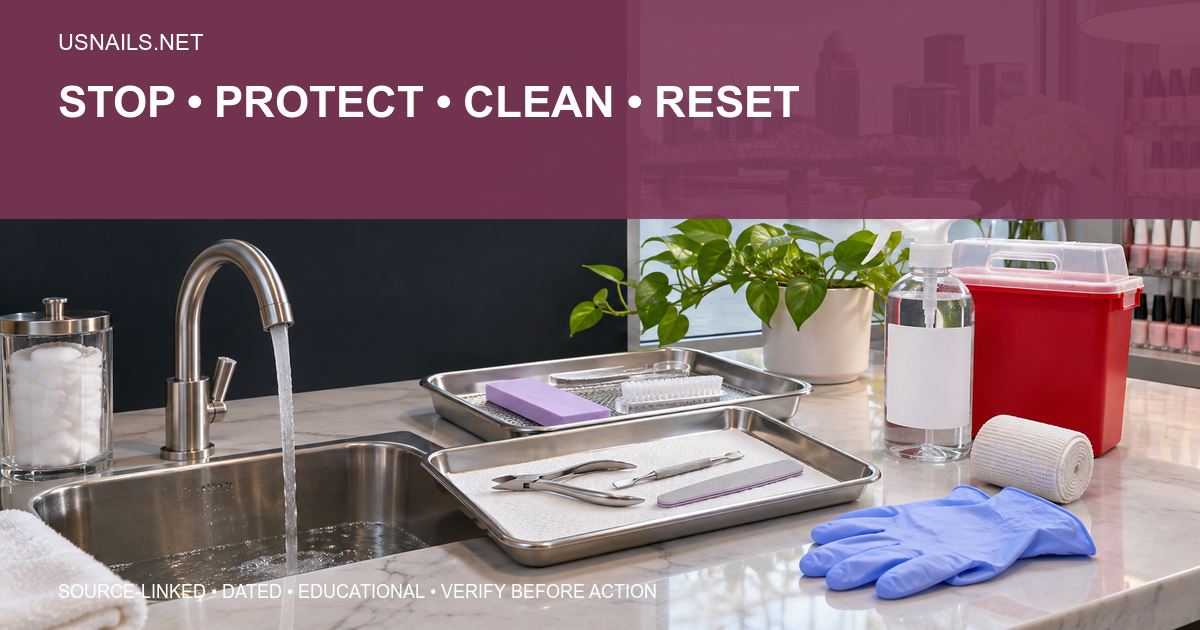
Blood Exposure at a Nail Station: Stop, Protect, Clean, Reset

Direct sources. Clear status. Practical public information.

Reviewed November 5, 2026 · Kentucky · current 201 KAR 12:100, Section 17. When a licensee or client is injured during a service and blood is present, the regulation says the service shall stop immediately. The remaining steps differ depending on who is injured and require gloves, cleaning, handwashing, disposal, and disinfection controls.

The station response card

  1. Stop: stop the service immediately when blood is present.
  2. Protect: follow the rule’s glove and handwashing sequence; avoid bare-hand contact.
  3. Clean the affected area: use clean running water when possible and follow the client-versus-licensee branch in Section 17.
  4. Control the station: clean blood from the workstation or client as the rule directs.
  5. Dispose: at service completion, immediately discard disposable items.
  6. Clean and disinfect: thoroughly clean and disinfect nonporous items; use manufacturer-label concentration and full contact time under the same regulation.
  7. Restart only after the control passes: the responsible licensee or facility must verify the person, surface, implements, and service state.

Important limits

This card is a plain-language reading of the cited Kentucky rule. It is not medical diagnosis or treatment guidance, does not replace workplace-safety duties or an exposure-control plan, and does not decide whether emergency care, medical evaluation, incident reporting, workers’ compensation, or another legal requirement applies. Pause for emergency services, a medical professional, the facility owner, the Kentucky Board of Cosmetology, or another responsible authority when the injury, exposure, contamination, or required next step is uncertain.

Privacy-minimized evidence

A training or quality record can preserve the date/time, station, response-step completion, responsible role, items removed, disinfection verification, restart authorization, and escalation route without publishing the client’s identity or health details.

Official source

Read the current full rule and the exact facility/workplace controls before acting.

Public-information notice: This Pulse is a dated, source-linked research summary for general educational use. It reports what the cited sources state or what the identified public record shows as of the date reviewed. Citation does not mean endorsement, partnership, certification, or independent confirmation of every third-party assertion. This is not individualized legal, medical, tax, accounting, investment, insurance, cybersecurity, licensing, regulatory, procurement, employment, real-estate, or other professional advice. Rules, facts, availability, and eligibility can change. Verify the controlling source, jurisdiction, effective date, and your own facts, and consult the responsible agency or a qualified professional before a consequential decision. External links are provided for attribution and may change. Use this information and any reader-controlled checklist at your own discretion and risk.