
Direct sources. Clear status. Practical public information.
Reviewed November 4, 2026 · Kentucky · current 201 KAR 12:100.
The current rule creates two visible storage states
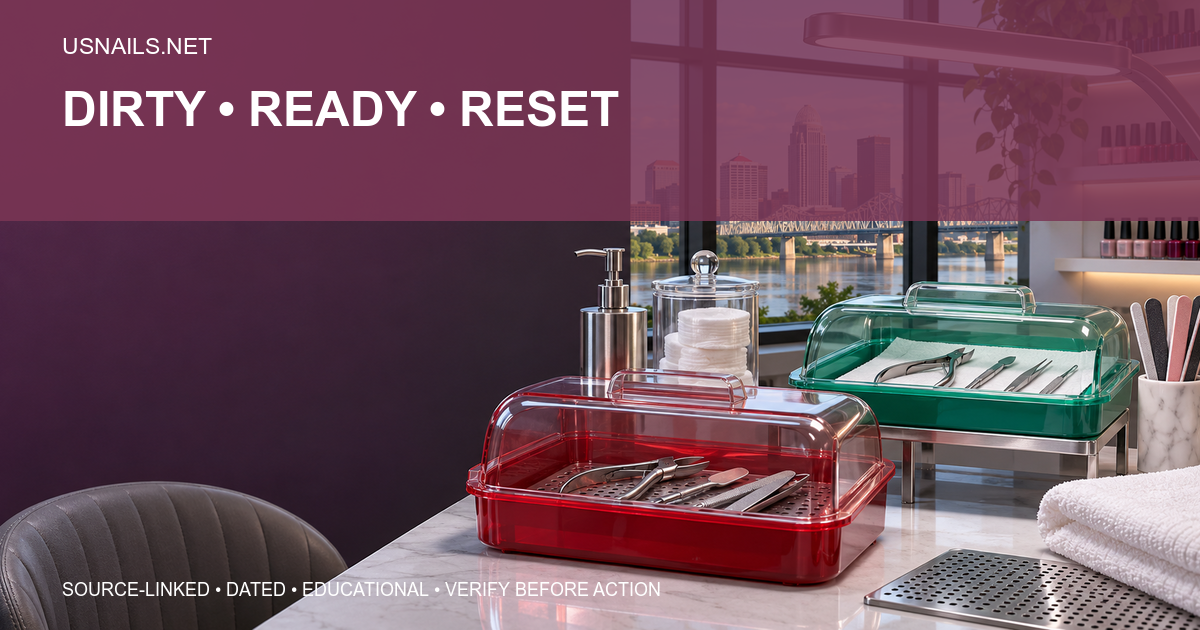
Section 3 says disinfected implements are stored in a clean, covered container, drawer, or bag labeled “disinfected” or “ready to use.” Dirty items are kept covered and labeled “dirty” until properly disinfected. Once an item enters the dirty container, drawer, or bag, it is not removed until the cleaning and disinfecting process has started.
Three-state station audit
| State | Evidence to check | Reset trigger |
|---|---|---|
| Dirty | Covered, clearly labeled, physically separated from ready items. | Open only to begin the cleaning/disinfection process. |
| Ready | Item completed cleaning, rinsing/drying, full label contact time, final rinse/dry when required, and covered labeled storage. | If the item becomes contaminated or its state is uncertain, remove it from ready storage and restart the applicable process. |
| Reset | Station and storage checked; dirty and ready zones restored; no reusable item has an unknown state. | Before the next service and whenever contamination, spill, mix-up, or unclear evidence occurs. |
A no-client-data audit card
- Date, station, responsible role, and rule/label version.
- Dirty container covered, labeled, and separate.
- Ready container clean, covered, labeled, and dry.
- Reusable item pathway completed; exact product label and manufacturer instructions checked.
- Unknown or contaminated item removed from ready state.
- Exception repaired and retested before return to service.
The card does not need a client’s name, health history, photograph, or service details.
What this audit does not prove
A storage check alone does not prove every cleaning step, disinfectant concentration, contact time, product expiration, facility condition, employee license, inspection result, or absence of contamination. Verify the current regulation, disinfectant label, implement instructions, and actual station.
Official sources
Sources reviewed November 4, 2026. The separately marked proposed-amendment page was not used as the current rule.
Public-information notice: This Pulse is a dated, source-linked research summary for general educational use. It reports what the cited sources state or what the identified public record shows as of the date reviewed. Citation does not mean endorsement, partnership, certification, or independent confirmation of every third-party assertion. This is not individualized legal, medical, tax, accounting, investment, insurance, cybersecurity, licensing, regulatory, procurement, employment, real-estate, or other professional advice. Rules, facts, availability, and eligibility can change. Verify the controlling source, jurisdiction, effective date, and your own facts, and consult the responsible agency or a qualified professional before a consequential decision. External links are provided for attribution and may change. Use this information and any reader-controlled checklist at your own discretion and risk.