Categories
Salon Safety

Contaminated Wax Pot: Kentucky’s Five-Step Reset

Direct sources. Clear status. Practical public information.

Information reviewed November 18, 2026, Eastern Time.

Stop and reset

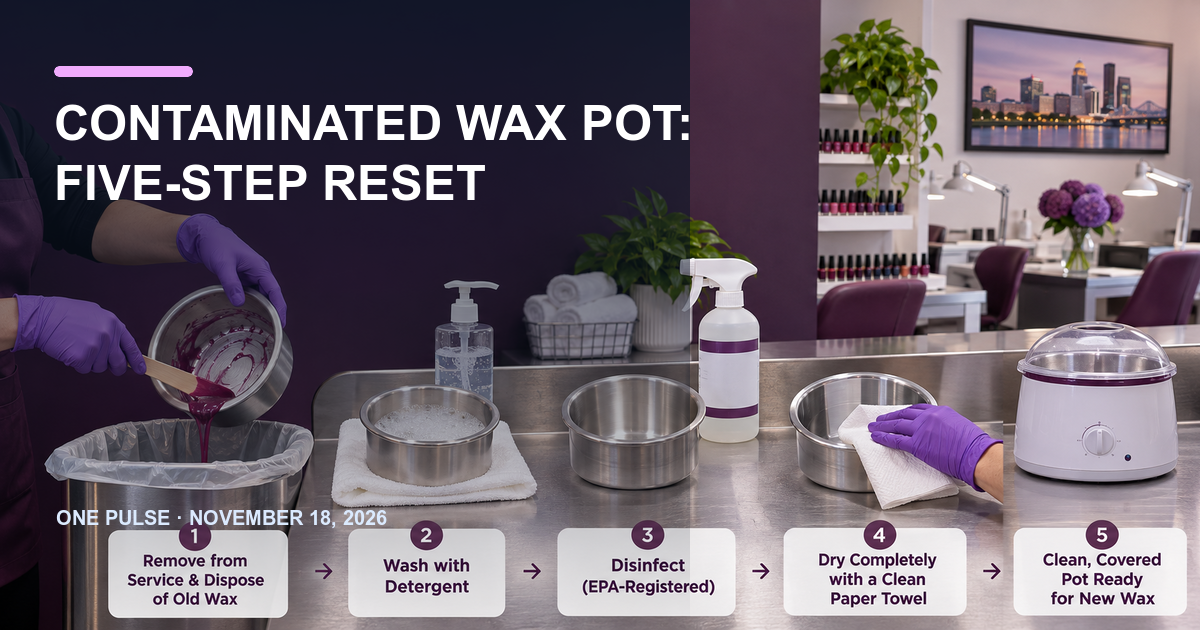
Under current 201 KAR 12:100, Section 9, if a wax pot becomes contaminated or visible debris appears, the pot must be completely cleaned and disinfected.

The five required steps

  1. Empty: dispose of the wax properly.
  2. Wash and rinse: wash the pot with detergent, then rinse it.
  3. Disinfect: wipe or spray all pot surfaces with an EPA-registered disinfectant, following the manufacturer’s contact-time directions.
  4. Dry: air dry or wipe dry with a clean paper towel.
  5. Refill and cover: use new wax and keep the pot covered.

Keep related rules separate

The same section says applicator sticks are single-dip and discarded immediately. It separately requires paraffin wax to be portioned to prevent cross-client contamination and discarded immediately. Those controls help prevent contamination; they do not replace the five-step pot reset after contamination or visible debris.

Reversible salon action

Remove the pot from service, complete the full reset, and document the date, operator, disinfectant label used, required contact time, and return-to-service check. Never shorten contact time or mix chemicals.

Limits

This explains the cited Kentucky rule; it does not diagnose infection or replace product labels, Safety Data Sheets, board guidance, or qualified medical advice. If exposure or injury occurs, follow the applicable blood-exposure and emergency procedures.

Optional next step

Place a five-step reset card near the wax station and verify that the disinfectant label and clean paper towels are immediately available.

Public-information notice: This Pulse is a dated, source-linked research summary for general educational use. It reports what the cited controlling sources state or what the identified public record shows as of November 18, 2026. Citation does not imply endorsement, partnership, certification, or independent confirmation of every third-party assertion. This is not individualized legal, medical, tax, accounting, investment, insurance, cybersecurity, licensing, regulatory, procurement, employment, real-estate, or other professional advice. Rules, records, availability, and eligibility can change. Verify the controlling source, jurisdiction, effective date, and your facts before a consequential decision. External links may change.

Categories
Sanitation & Safety

The Drill-Bit Control Card: Use, Clean, Disinfect, Store

Direct sources. Clear status. Practical public information.

A reusable nonporous nail drill bit does not move directly from “used” to “ready.” Kentucky’s current facility rule separates cleaning, disinfection, drying, and protected storage. A quick wipe or an unlabeled drawer is not the same evidence chain.

The four-state drill-bit card

State Control question Evidence to preserve
Used / dirty Was the implement moved immediately into the covered, labeled dirty control? Station reset check; no client identity or health detail.
Cleaned Were visible debris and residue removed before disinfection? Approved cleaning method and responsible person/time.
Disinfected and dried Was an appropriate EPA-registered disinfectant used for its full labeled contact time, followed by required rinse/dry steps? Product identity, label/contact-time check, solution state, and completion.
Protected / ready Was the dry implement placed in a clean, covered container, drawer, or bag labeled “disinfected” or “ready to use”? Protected storage location and next-use readiness check.

Five fields for a minimal station log

  1. Implement class: reusable nonporous drill bit; stop if material or manufacturer instructions do not support the process.
  2. Dirty-control entry: time/station and covered labeled location—without patron identity.
  3. Cleaning step: debris removed with the approved method.
  4. Disinfection step: product, concentration/preparation, full label contact time, completion, rinse/dry if required.
  5. Ready-storage step: clean, dry, covered, labeled storage and responsible reset owner.

Label control matters

The regulation’s contact-time requirement points back to the disinfectant manufacturer’s directions. If a product does not identify disinfecting contact time, the public Kentucky text says it is not an EPA-registered disinfectant and shall not be used as one. The exact product label and manufacturer instructions control the specific use.

Reader-controlled station check

  • Is the bit reusable, nonporous, intact, and approved for this process?
  • Can dirty and ready states be distinguished without memory?
  • Was visible residue removed before disinfection?
  • Was the full label contact time completed?
  • Is the bit dry and protected in a clean, covered, labeled container?
  • Who stops use when material, damage, label, solution, timing, or storage is uncertain?

Human stop point

Stop when the implement’s material, condition, manufacturer instructions, cleaning method, disinfectant registration, concentration, contact time, solution state, blood exposure, or storage status is unknown. Follow the controlling rule, product label, manufacturer directions, facility policy, and responsible licensed professional.

What USNails.net can contribute

USNails.net can provide a privacy-minimized training card that separates dirty, cleaned, disinfected, dried, and protected-ready states. It does not inspect a facility, certify an implement or product, replace a licensee’s duties, or give individualized health or legal advice.

Official source

Jurisdiction: Kentucky. Current public regulation observed October 31, 2026. Verify the exact implement, product label, facility policy, and current rule before use.

Public-information notice: This Pulse is a dated, source-linked research summary for general educational use. It reports what the cited sources state or what the identified public record shows as of the date reviewed. Citation does not mean endorsement, partnership, certification, or independent confirmation of every third-party assertion. This is not individualized legal, medical, tax, accounting, investment, insurance, cybersecurity, licensing, regulatory, procurement, employment, real-estate, or other professional advice. Rules, facts, availability, and eligibility can change. Verify the controlling source, jurisdiction, effective date, and your own facts, and consult the responsible agency or a qualified professional before a consequential decision. External links are provided for attribution and may change. Use this information and any reader-controlled checklist at your own discretion and risk.

Categories
Sanitation & Safety

Hand Sanitizer at the Nail Station: Three Separate Before-Service Controls

Direct sources. Clear status. Practical public information.

Kentucky’s current salon infection-control rule creates three separate before-service controls at a nail station: the station surface, the patron’s access to hand sanitizer, and the licensed professional’s own hand cleansing. One sanitizer bottle does not silently complete all three.

The three-control map

Control Current Kentucky source language, in plain terms What it does not replace
Nail-station surface Section 7 requires nail-station surfaces to be disinfected between clients. Cleaning, product-label contact time, tool processing, or hand hygiene.
Patron sanitizer Section 7 says nail clients are offered hand sanitizer before a service; Section 16 says sanitizer is available for patron use at each nail station. The professional’s own hand cleansing or station disinfection.
Professional hands Section 16 requires every person licensed or permitted by the Board to thoroughly cleanse their hands with soap and water or an equally effective hand sanitizer immediately before serving each patron. The patron offer, surface disinfection, or processing of implements.

A five-field opening line for each service

  1. Station: non-client station identifier and the between-client disinfection completion time.
  2. Product route: disinfectant identity plus label-required preparation and contact time; do not guess a universal wet time.
  3. Patron access: sanitizer available at the station and offered before the service.
  4. Professional hands: hand-cleansing step completed immediately before serving the patron under the current rule and facility procedure.
  5. Exception and stop: missing label, empty/expired product, visibly contaminated or damaged surface, unresolved skin/safety concern, or incomplete step is recorded and corrected before service continues.

What to keep separate

  • Available is not offered. A visible dispenser can support access, but the current Section 7 language also describes an offer before service.
  • Offered is not used. The record should not invent patron action or collect unnecessary private information.
  • Patron sanitizer is not professional hand cleansing. Section 16 places a separate immediate-before-service duty on the licensed or permitted person.
  • Hand hygiene is not surface disinfection. Section 7 separately addresses the nail-station surface between clients.
  • A checkmark is not independent proof. It records that a responsible person marked the control; the real procedure, product label, supervision, and facility evidence still matter.

Privacy-minimized station card

Field Record Exclude
Station/time Station identifier and completed reset time. Client name or private service detail.
Surface control Clean/disinfect route and label contact-time evidence. Unsupported claim that the entire facility is compliant.
Patron control Sanitizer available and offered. Health condition, refusal reason, or unnecessary identity.
Professional control Immediate-before-service hand-cleansing completion. Medical claim or guarantee that transmission is impossible.
Correction Exact missing step, responsible owner, repair, and recheck. Blame or invented explanation.

Reader stop point

Pause the service when the station has not completed its between-client process, the product label or required contact time is unavailable, patron sanitizer is not available for the required station control, the professional cannot complete the immediate hand-cleansing step, or another health/safety rule creates a stop. Confirm the current regulation, Board guidance, exact product label, manufacturer instructions, and responsible licensed professional before continuing.

What USNails.net can contribute

USNails.net can turn the current public rule into a short training and evidence card that keeps surface disinfection, patron sanitizer, and professional hand cleansing separate. It does not inspect a facility, select a product, diagnose a condition, guarantee infection prevention, or replace the Kentucky Board of Cosmetology, manufacturer label, facility procedure, or responsible licensed professional.

Official source

Jurisdiction: Kentucky. Current regulation observed October 30, 2026. This is a general record-building guide, not a facility inspection or individualized health/compliance determination.

Public-information notice: This Pulse is a dated, source-linked research summary for general educational use. It reports what the cited sources state or what the identified public record shows as of the date reviewed. Citation does not mean endorsement, partnership, certification, or independent confirmation of every third-party assertion. This is not individualized legal, medical, tax, accounting, investment, insurance, cybersecurity, licensing, regulatory, procurement, employment, real-estate, or other professional advice. Rules, facts, availability, and eligibility can change. Verify the controlling source, jurisdiction, effective date, and your own facts, and consult the responsible agency or a qualified professional before a consequential decision. External links are provided for attribution and may change. Use this information and any reader-controlled checklist at your own discretion and risk.

Categories
Sanitation & Safety

Foot Spa Between Clients: A Kentucky Six-Step Reset Log

Direct sources. Clear status. Practical public information.

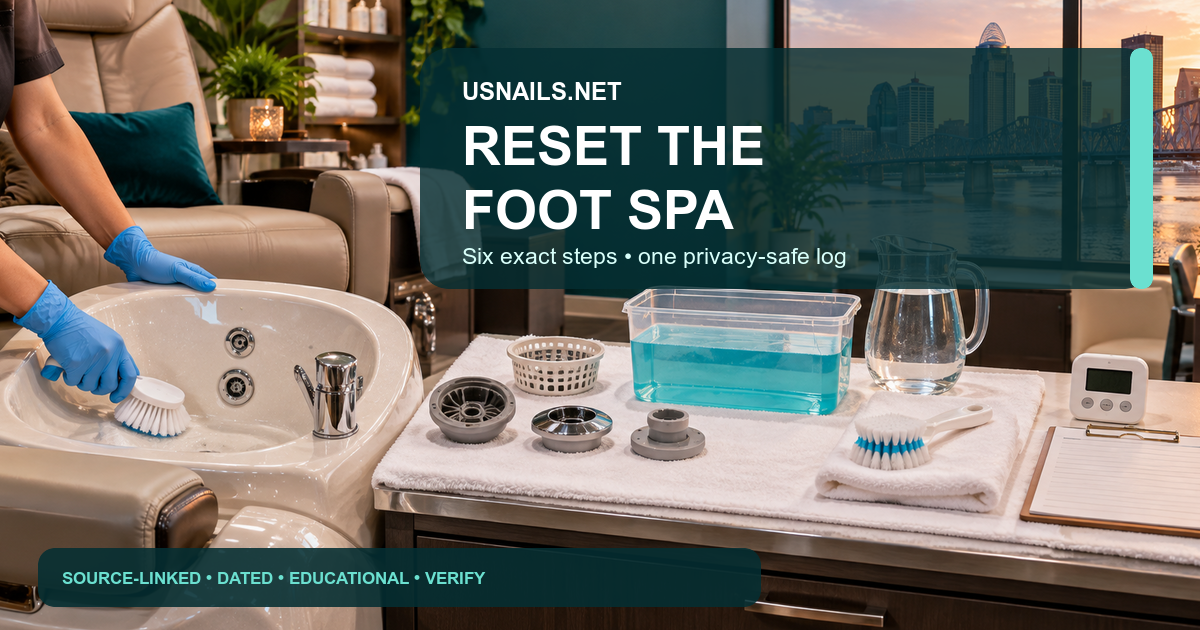
Kentucky’s current infection-control regulation does not treat a pedicure-station reset as one vague “cleaning” action. Under 201 KAR 12:100, Section 7, pedicure stations are cleaned and disinfected after each use through a sequence that changes slightly depending on whether the bowl circulates water.

The useful operating question is: Can the salon prove that the complete between-client sequence was finished for this station?

The current Kentucky sequence

  1. Remove: take out all removable parts.
  2. Empty and scrub: empty the bowl and scrub it with detergent and a scrub brush.
  3. Rinse and refill: rinse the bowl and fill it with clean water.
  4. Measure: add an appropriate disinfectant at the proper concentration for the bowl size.
  5. Run or stand: for a circulating/whirlpool bowl, circulate the disinfectant for the full label contact time; for a non-circulating bowl, let it stand for the full label contact time.
  6. Complete and document: finish the reset, return removable parts only after their applicable cleaning/disinfection path, and record the completed control without client identity or private information.

The six-field reset log

Field Record Limit
Station and finish time Non-client station identifier and reset completion time. No client name, service details, or health information.
Removable parts Removed; separate applicable cleaning/disinfection path completed. A checkmark does not replace the required procedure.
Wash and rinse Bowl emptied, scrubbed with detergent/brush, rinsed, and refilled with clean water. Visible cleanliness alone is not disinfection.
Disinfectant Product identifier, concentration/dilution, prepared state, and label route. This guide does not select a product or universal dilution.
Contact time Label-required time plus circulating or standing method. Do not guess a universal number; the current label controls.
Human verification Responsible licensed professional/owner control and any corrective action. The log does not certify Board inspection or legal compliance by itself.

Three common record failures

  • “Cleaned” without a sequence: the record does not distinguish scrubbing, rinsing, concentration, or contact time.
  • A guessed universal contact time: Kentucky’s rule points to the manufacturer’s label, and the current product may require a different time.
  • A client record disguised as a sanitation log: sanitation proof generally does not need a client’s identity, condition, or private service detail.

Reader stop point

Pause the service when the product label is missing or unclear, the station cannot be safely emptied or circulated, the disinfectant is diluted or soiled, the bowl or removable part is damaged, or the person responsible cannot verify the required sequence. Confirm the current rule, product label, manufacturer instructions, and responsible authority before continuing.

What the record establishes—and does not

A completed log can document that a responsible person recorded the listed steps for the named station at a named time. It does not independently prove the product was effective, the concentration was correct, every surface was reached, an inspection passed, or the facility complied with every applicable rule.

What USNails.net can contribute

USNails.net can translate the public rule into a practical, privacy-minimized training log and help owners separate cleaning, disinfection, label contact time, and evidence. It does not replace the Kentucky Board of Cosmetology, product label, manufacturer, inspector, or licensed professional responsible for the service.

Official sources

Jurisdiction: Kentucky. Official sources observed October 29, 2026. The current regulation and exact manufacturer label control the real service.

Public-information notice: This Pulse is a dated, source-linked research summary for general educational use. It reports what the cited sources state or what the identified public record shows as of the date reviewed. Citation does not mean endorsement, partnership, certification, or independent confirmation of every third-party assertion. This is not individualized legal, medical, tax, accounting, investment, insurance, cybersecurity, licensing, regulatory, procurement, employment, real-estate, or other professional advice. Rules, facts, availability, and eligibility can change. Verify the controlling source, jurisdiction, effective date, and your own facts, and consult the responsible agency or a qualified professional before a consequential decision. External links are provided for attribution and may change. Use this information and any reader-controlled checklist at your own discretion and risk.

Categories
Sanitation & Safety

Single-Use or Multi-Use? A Kentucky Nail-Product Container Check

Direct sources. Clear status. Practical public information.

Product contamination can begin before an implement touches a client. Kentucky’s current infection-control regulation separates items that cannot be cleaned and disinfected, products removed from multi-use containers, powders and lotions dispensed through pumps or shakers, and leftover product in single-use containers.

The practical question is not only “Is this product clean?” It is: What container and dispensing path does the current rule require for this item and this service?

What the current Kentucky rule says

  • An item that cannot be cleaned and disinfected is considered single use and is disposed of after each use. The regulation gives examples including most nonmetal/non-glass nail files, cotton, buffing blocks, pumice stones, wooden cuticle pushers, toe separators, wooden spatulas, neck strips, and paper coverings.
  • Product removed from a multi-use tub or tube must be taken out in a way that prevents contamination of the remaining product.
  • Pomades, waxes, and gels are removed with either a disposable single-use spatula or a disinfected multi-use spatula; fingers are not used to remove product.
  • Powders and lotions are dispensed through a shaker or pump so hands do not touch the dispensing parts.
  • Single-use product containers are used whenever possible to prevent contamination of unused solution, and leftover product is disposed of rather than reused.

The container decision card

Question Control Evidence
Can the item be cleaned and disinfected? If not, classify it as single use and discard after one use. Item type, service, disposal check.
Is product coming from a multi-use tub or tube? Prevent contact with the remaining product. Dispensing method and clean/disinfected tool.
Is a spatula needed? Use a disposable single-use spatula or a disinfected multi-use spatula; no fingers. Spatula state before removal.
Is it powder or lotion? Use a shaker or pump without touching the dispensing portion. Container and dispenser condition.
Was product portioned into a single-use container? Dispose of leftover product; do not return or reuse it. Portion, service, discard completion.

Opening, service, and closing checks

  1. Opening: label clean/disinfected multi-use tools, stock single-use items, inspect pumps/shakers, and remove damaged or contaminated containers.
  2. Before service: identify the item and dispensing path before opening the product.
  3. During service: prevent hands, used tools, and client-contact items from touching the remaining product or dispensing portion.
  4. After service: discard single-use items and leftover single-use portions; route reusable nonporous tools through the full cleaning and disinfection process.
  5. Closing: document shortages, contamination events, damaged dispensers, disposal, and corrective action.

Important limits

This article does not decide whether a particular branded item, medical device, product, service, container, or facility practice complies. The current regulation, manufacturer directions, product label, device instructions, Board guidance, and actual facts may all matter. Stop the service and confirm with the responsible authority or qualified professional when the item cannot be safely classified or handled.

What USNails.net can contribute

USNails.net can turn the public rule into a practical training card and evidence log for owners and licensed professionals. It does not replace the Kentucky Board of Cosmetology, product label, manufacturer, inspector, or licensed professional responsible for the service.

Official sources

Jurisdiction: Kentucky. Current-regulation index and official text observed October 28, 2026. Recheck the controlling source and exact product instructions before use.

Public-information notice: This Pulse is a dated, source-linked research summary for general educational use. It reports what the cited sources state or what the identified public record shows as of the date reviewed. Citation does not mean endorsement, partnership, certification, or independent confirmation of every third-party assertion. This is not individualized legal, medical, tax, accounting, investment, insurance, cybersecurity, licensing, regulatory, procurement, employment, real-estate, or other professional advice. Rules, facts, availability, and eligibility can change. Verify the controlling source, jurisdiction, effective date, and your own facts, and consult the responsible agency or a qualified professional before a consequential decision. External links are provided for attribution and may change. Use this information and any reader-controlled checklist at your own discretion and risk.

Categories
Sanitation & Safety

Clean Towels Need Protected Storage: A Kentucky Linen-Control Card

Direct sources. Clear status. Practical public information.

A towel can be freshly washed and still become a sanitation problem if it is left exposed or mixed with used linen. Kentucky’s current infection-control rule treats laundering, clean storage, and soiled-linen collection as three separate controls.

The reusable lesson for a nail professional is simple: clean is a process; protected storage preserves the result.

What Kentucky’s current rule says

201 KAR 12:100, Section 15, observed as current October 27, 2026, says:

  • cloth towels, robes, and similar items are laundered in a washing machine with laundry detergent used according to the manufacturer’s directions;
  • a commercial laundry service may be used;
  • a closed, dustproof cabinet is provided for clean towels and linen; and
  • a closed, side-vented hamper or receptacle is provided for soiled towels and linens.

The rule does not say that a clean-looking open shelf, a shared basket, or a plastic bag automatically meets those separate storage functions.

The linen-control card

Checkpoint Opening check Closing evidence
Laundering Only processed clean linen enters clean storage. Load/service receipt, detergent method, date, responsible person.
Clean cabinet Closed, dustproof, dry, and reserved for clean linen. Cabinet emptied of unrelated/soiled items; door closes.
Soiled receptacle Closed, side-vented, lined or handled per facility procedure, and clearly separate. Contents moved to the laundering route without crossing clean storage.
Service flow Staff can reach clean linen without touching the soiled container. No used towel returns to a clean surface or cabinet.
Exception Spill, damaged cabinet, overflow, or mix-up is recorded. Affected linen is reprocessed; control is repaired before reuse.

A one-minute station check

  1. Close the clean cabinet and confirm it is dry and free of dust or unrelated items.
  2. Confirm the soiled-linen receptacle is separate, closed, and side vented.
  3. Trace one towel from clean storage to service use to the soiled receptacle.
  4. Remove any towel whose clean/used status is uncertain and reprocess it.
  5. Record the owner and correction when storage or separation fails.

What this card does not establish

This card does not certify a salon, replace an inspection, approve a laundry product, set a manufacturer’s detergent instructions, or decide every facility’s exact layout. It also does not replace other Kentucky requirements for hand hygiene, implements, work surfaces, blood exposure, trash, disinfectant labels, or service-specific controls.

Why the distinction matters

When the clean and soiled lanes are visibly different, staff can correct a failure before the next service. The reversible action is to remove uncertain linen, reprocess it, restore the protected-storage boundary, and document the correction.

What USNails.net can contribute

USNails.net can translate public sanitation rules into short training cards and observation logs for licensed professionals and salon teams. It does not inspect, license, certify, diagnose, prescribe, or replace the Kentucky Board of Cosmetology, a product label, manufacturer instructions, or qualified health/safety review.

Official source

Jurisdiction: Kentucky. Regulation observed as current October 27, 2026; Section 15 controls the quoted laundering and storage requirements. Recheck the official regulation and applicable product/manufacturer instructions before implementation.

Public-information notice: This Pulse is a dated, source-linked research summary for general educational use. It reports what the cited sources state or what the identified public record shows as of the date reviewed. Citation does not mean endorsement, partnership, certification, or independent confirmation of every third-party assertion. This is not individualized legal, medical, tax, accounting, investment, insurance, cybersecurity, licensing, regulatory, procurement, employment, real-estate, or other professional advice. Rules, facts, availability, and eligibility can change. Verify the controlling source, jurisdiction, effective date, and your own facts, and consult the responsible agency or a qualified professional before a consequential decision. External links are provided for attribution and may change. Use this information and any reader-controlled checklist at your own discretion and risk.