Categories
Salon Safety and Compliance

Bottle Label + Safety Data Sheet: Two Records Before a Nail Product Enters Service

Direct sources. Clear status. Practical public information.

Reviewed November 10, 2026 · U.S. nail-salon chemical-hazard guidance · current OSHA nail-salon page.

OSHA’s nail-salon guidance tells workers to read product labels and Safety Data Sheets (SDSs). It also says that when chemicals are moved from a large bottle into a smaller container, the smaller container should be labeled with the information on the manufacturer’s label.

Two records before service

Record Minimum check
Container label Exact product identity, manufacturer label or supportable workplace label, hazard/handling information, intact and readable condition, and match to the product actually inside.
Safety Data Sheet Exact product/manufacturer, current controlled copy or accessible route, hazard and protective information, storage/spill/first-aid sections, and worker access.

Five-step receiving card

  1. Match product, manufacturer, container, lot/batch when available, and SDS identity.
  2. Do not use an unlabeled, mismatched, leaking, damaged, expired, recalled, or otherwise held product until the responsible person resolves it.
  3. Preserve the manufacturer’s instructions and the applicable federal, state, and local requirements.
  4. Train workers on the actual products and keep the SDS access route working during the shift.
  5. Record correction, disposal/return, replacement, retraining, and responsible review.

Limits

This article does not classify every product, replace an employer’s hazard-communication program, certify an SDS, prescribe personal protective equipment, diagnose exposure, or determine all legal duties. The actual label, current SDS, manufacturer, responsible employer, Kentucky requirements, emergency guidance, and qualified safety/medical professionals control.

Official sources

Public-information notice: This Pulse is a dated, source-linked research summary for general educational use. It reports what the cited sources state or what the identified public record shows as of the date reviewed. Citation does not mean endorsement, partnership, certification, or independent confirmation of every third-party assertion. This is not individualized legal, medical, tax, accounting, investment, insurance, cybersecurity, licensing, regulatory, procurement, employment, real-estate, or other professional advice. Rules, facts, availability, and eligibility can change. Verify the controlling source, jurisdiction, effective date, and your own facts, and consult the responsible agency or a qualified professional before a consequential decision. External links are provided for attribution and may change. Use this information and any reader-controlled checklist at your own discretion and risk.
Categories
Salon Safety and Compliance

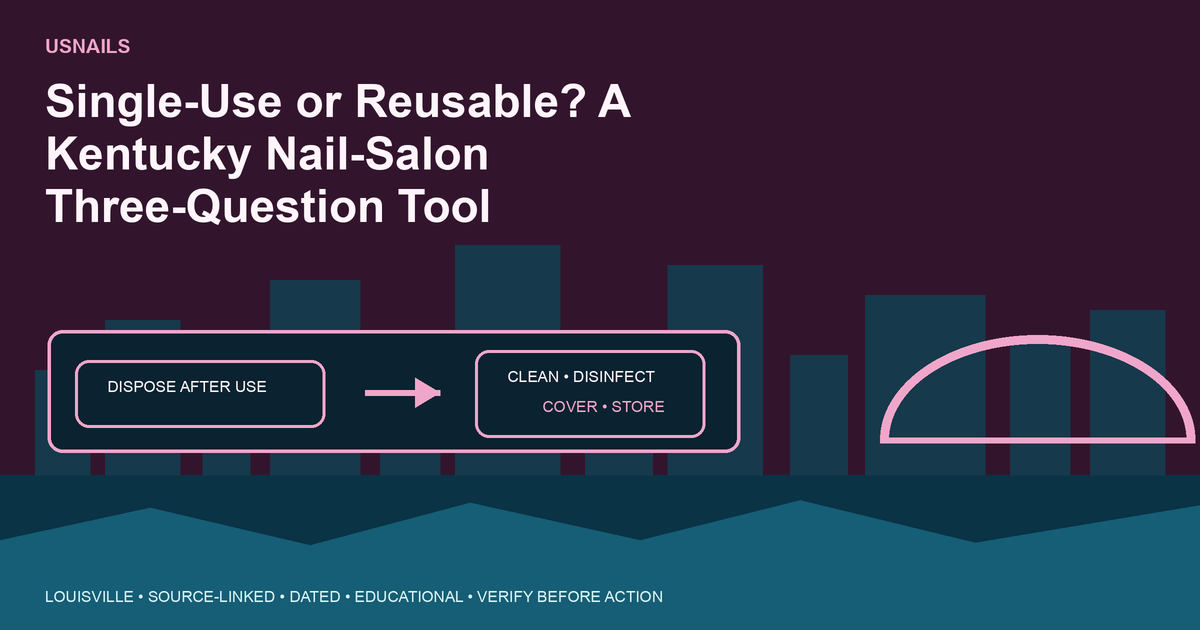
Single-Use or Reusable? A Kentucky Nail-Salon Three-Question Tool

Direct sources. Clear status. Practical public information.

Reviewed November 9, 2026 · Kentucky licensed facilities · current 201 KAR 12:100, especially Sections 10–12.

Kentucky’s facility rule states that an item that may not be cleaned and disinfected is considered single use and must be disposed of after each use. It separately requires nonporous items used on multiple clients to be cleaned and disinfected after each use. The safest record keeps the item, material, service, and next state visible.

Three questions at the station

Question If yes If no or unknown
1. Can the item be cleaned and disinfected under the rule and manufacturer instructions? Continue to question 2. Treat it as single use and dispose after use; do not improvise a reuse method.
2. Is it a nonporous multi-client implement or surface with a supportable cleaning/disinfection method? Clean, rinse/dry as applicable, disinfect for the full labeled contact time, and store in the correct clean covered state. Stop and confirm the item-specific rule and manufacturer direction.
3. Does the service have a more specific one-time-use or contamination rule? Follow the specific rule—for example, single-dip wax applicators, unused exposed lash extensions, or single-use spatulas. Keep the general item control and inspection evidence.

Examples named by the current rule

Section 10 lists examples of items treated as single use when they cannot be cleaned and disinfected, including many nonmetal or nonglass nail files/emery boards, cotton, buffing blocks, pumice stones, wooden cuticle pushers, toe separators, wooden spatulas, neck strips, and paper coverings. The list supports classification; it does not authorize reuse of a different item merely because its name is absent.

Four-field item card

  1. Identity: item, material, manufacturer/label, station, and service.
  2. Classification: single use, reusable nonporous, service-specific, or held for clarification.
  3. Action: dispose, clean, disinfect, dry, cover/store, or remove from service.
  4. Evidence: date/time, responsible person, product/contact time where applicable, exception/correction, and supervisor review.

Limits and stop point

This article does not inspect a facility or classify every product, device, porous material, electrical tool, chemical, medical device, or service. The current regulation, manufacturer label, board guidance, facility owner, and qualified safety or legal professionals control the actual decision. When material or method is uncertain, remove the item from use until the responsible person verifies it.

Official source

Public-information notice: This Pulse is a dated, source-linked research summary for general educational use. It reports what the cited sources state or what the identified public record shows as of the date reviewed. Citation does not mean endorsement, partnership, certification, or independent confirmation of every third-party assertion. This is not individualized legal, medical, tax, accounting, investment, insurance, cybersecurity, licensing, regulatory, procurement, employment, real-estate, or other professional advice. Rules, facts, availability, and eligibility can change. Verify the controlling source, jurisdiction, effective date, and your own facts, and consult the responsible agency or a qualified professional before a consequential decision. External links are provided for attribution and may change. Use this information and any reader-controlled checklist at your own discretion and risk.

Categories
Salon Safety and Compliance

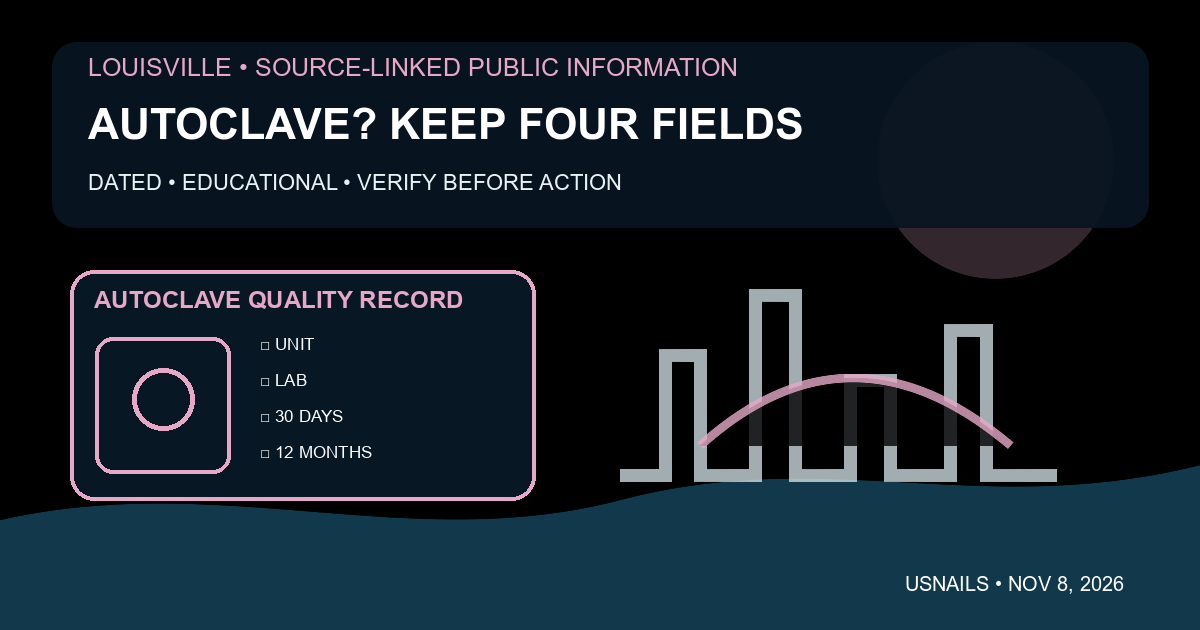
If a Kentucky Salon Uses an Autoclave: Four Fields for the Monthly Spore-Test Record

Direct sources. Clear status. Practical public information.

Reviewed November 8, 2026 · Kentucky · 201 KAR 12:100. The rule is conditional: it addresses autoclaves used to sterilize. This article does not say that every salon or service must use an autoclave.

Four fields for the quality-control record

Field Evidence question
Exact unit Which autoclave produced the cycle, and how is the unit identified at the facility?
Independent laboratory Which independent laboratory performed the spore test, and what result was reported?
Test cadence Does the dated record demonstrate the every-thirty-days requirement for an autoclave used to sterilize?
Onsite retention Are the results available onsite for the required twelve months?

Reversible monthly check

  1. Confirm that the device in question is the salon’s identified autoclave and that the rule applies to its use.
  2. Match the independent-laboratory result to the unit and test date.
  3. Record the next due date without changing the official result.
  4. Keep the result onsite for twelve months and preserve any corrective action, service, or retest evidence separately.
  5. Do not substitute a cleaning log, purchase receipt, cycle printout, or internal observation for the independent-laboratory spore-test result.
  6. Pause the affected process and consult the responsible licensee, Board of Cosmetology, manufacturer instructions, or qualified professional when a result is missing, late, failed, disputed, or mismatched.

Limits

This record card does not validate a device, laboratory, cycle, sterilization claim, facility, service, infection-control plan, or inspection outcome. Other sanitation, disinfection, single-use, manufacturer, occupational-safety, and service-specific requirements may also apply. The current regulation and responsible authority control.

Official source

Public-information notice: This Pulse is a dated, source-linked research summary for general educational use. It reports what the cited sources state or what the identified public record shows as of the date reviewed. Citation does not mean endorsement, partnership, certification, or independent confirmation of every third-party assertion. This is not individualized legal, medical, tax, accounting, investment, insurance, cybersecurity, licensing, regulatory, procurement, employment, real-estate, or other professional advice. Rules, facts, availability, and eligibility can change. Verify the controlling source, jurisdiction, effective date, and your own facts, and consult the responsible agency or a qualified professional before a consequential decision. External links are provided for attribution and may change. Use this information and any reader-controlled checklist at your own discretion and risk.