
Direct sources. Clear status. Practical public information.
Reviewed November 8, 2026 · Kentucky · 201 KAR 12:100. The rule is conditional: it addresses autoclaves used to sterilize. This article does not say that every salon or service must use an autoclave.
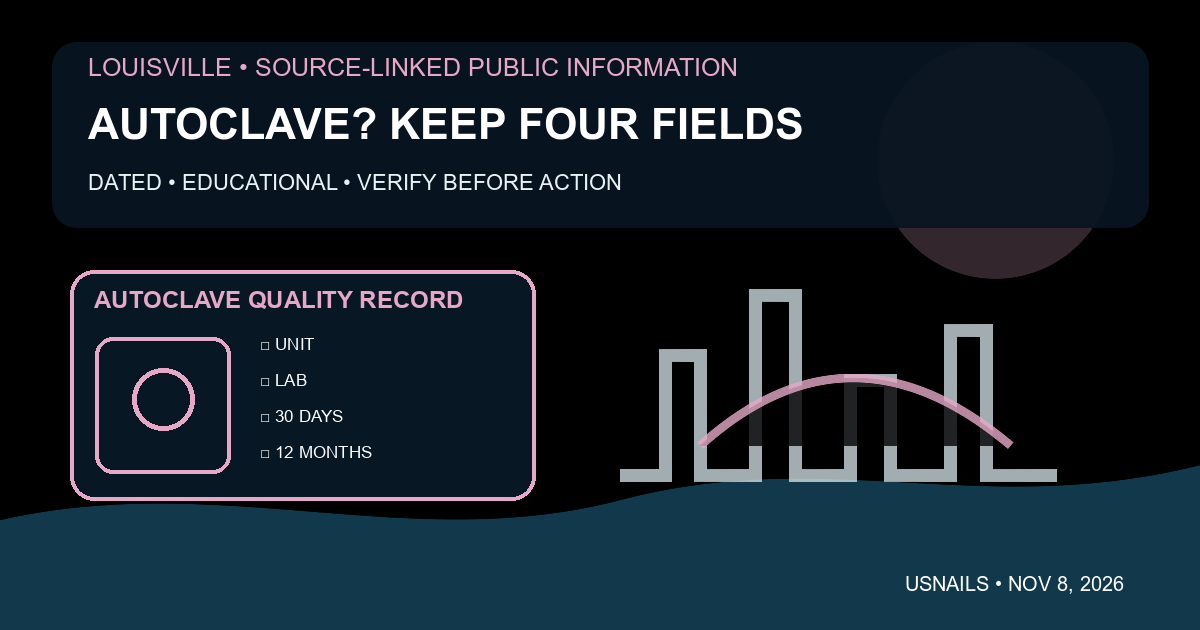
Four fields for the quality-control record
| Field | Evidence question |
|---|---|
| Exact unit | Which autoclave produced the cycle, and how is the unit identified at the facility? |
| Independent laboratory | Which independent laboratory performed the spore test, and what result was reported? |
| Test cadence | Does the dated record demonstrate the every-thirty-days requirement for an autoclave used to sterilize? |
| Onsite retention | Are the results available onsite for the required twelve months? |
Reversible monthly check
- Confirm that the device in question is the salon’s identified autoclave and that the rule applies to its use.
- Match the independent-laboratory result to the unit and test date.
- Record the next due date without changing the official result.
- Keep the result onsite for twelve months and preserve any corrective action, service, or retest evidence separately.
- Do not substitute a cleaning log, purchase receipt, cycle printout, or internal observation for the independent-laboratory spore-test result.
- Pause the affected process and consult the responsible licensee, Board of Cosmetology, manufacturer instructions, or qualified professional when a result is missing, late, failed, disputed, or mismatched.
Limits
This record card does not validate a device, laboratory, cycle, sterilization claim, facility, service, infection-control plan, or inspection outcome. Other sanitation, disinfection, single-use, manufacturer, occupational-safety, and service-specific requirements may also apply. The current regulation and responsible authority control.
Official source
Public-information notice: This Pulse is a dated, source-linked research summary for general educational use. It reports what the cited sources state or what the identified public record shows as of the date reviewed. Citation does not mean endorsement, partnership, certification, or independent confirmation of every third-party assertion. This is not individualized legal, medical, tax, accounting, investment, insurance, cybersecurity, licensing, regulatory, procurement, employment, real-estate, or other professional advice. Rules, facts, availability, and eligibility can change. Verify the controlling source, jurisdiction, effective date, and your own facts, and consult the responsible agency or a qualified professional before a consequential decision. External links are provided for attribution and may change. Use this information and any reader-controlled checklist at your own discretion and risk.