
Direct sources. Clear status. Practical public information.
A reusable tool is not ready because it looks clean. Kentucky’s current infection-control rule separates cleaning, disinfection contact time, rinsing/drying, and covered labeled storage.
The four-condition ready check
| Condition | Verify | Reset trigger |
|---|---|---|
| Process complete | The nonporous implement was cleaned, rinsed, disinfected for the product’s full contact time, then rinsed when required. | Unknown product, concentration, contact time, or incomplete process. |
| Dry | The implement was dried with a single-use paper towel or air dried before ready storage. | Visible moisture, residue, debris, or uncertain drying state. |
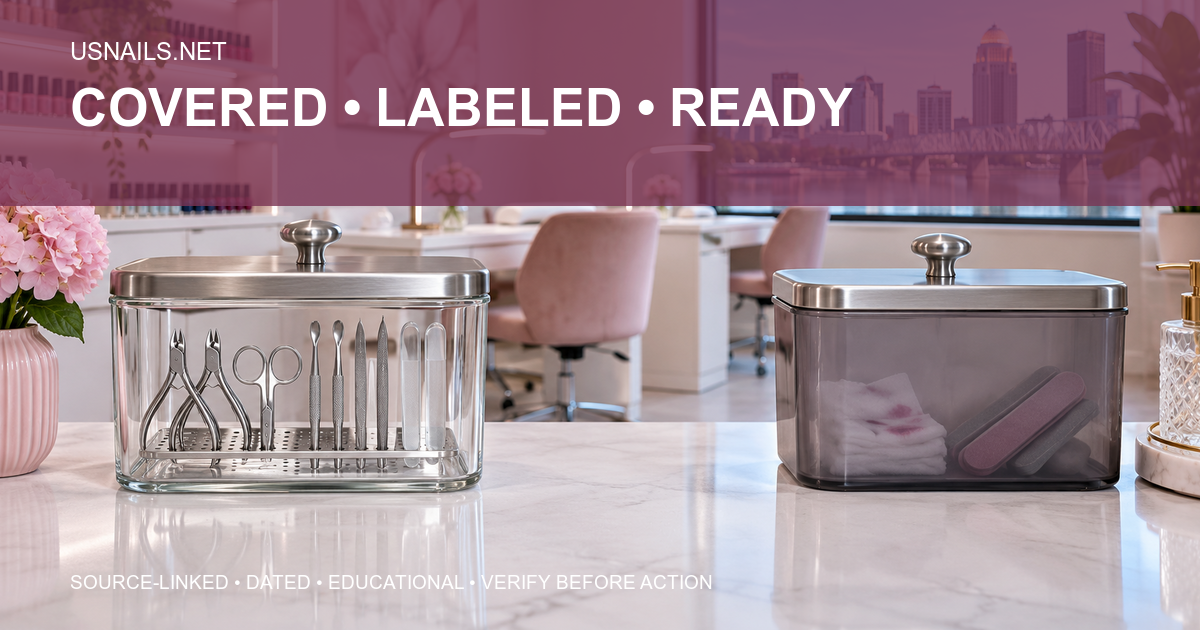
| Covered | The ready item is inside a clean, covered container, drawer, or bag. | Open exposure, contact with a dirty surface/item, pocket/apron storage, or damaged container. |
| Labeled and separated | The storage is labeled “disinfected” or “ready to use,” while dirty items remain covered/labeled and do not return to service before reprocessing. | Mixed states, missing label, or any item placed in the dirty area. |
A privacy-minimized station record
- Date/shift and station—not client identity.
- Reusable tool class and manufacturer instructions checked.
- Disinfectant product/lot or station batch, concentration, and contact time.
- Drying method and ready-container identity.
- Reset reason, correction, and person who verified the new ready state.
What this check does not establish
It does not replace the current regulation, manufacturer label, facility procedure, Board inspection, or professional judgment. It does not make a single-use item reusable, prove sterilization, or decide a particular exposure or health issue.
What USNails can contribute
USNails can teach a clear station-state vocabulary and a low-burden evidence card. It does not inspect facilities, certify compliance, diagnose conditions, or approve a product or process.
Official sources
Sources reviewed November 3, 2026. Verify the current effective text, disinfectant label, tool instructions, and exact facility facts.
Public-information notice: This Pulse is a dated, source-linked research summary for general educational use. It reports what the cited sources state or what the identified public record shows as of the date reviewed. Citation does not mean endorsement, partnership, certification, or independent confirmation of every third-party assertion. This is not individualized legal, medical, tax, accounting, investment, insurance, cybersecurity, licensing, regulatory, procurement, employment, real-estate, or other professional advice. Rules, facts, availability, and eligibility can change. Verify the controlling source, jurisdiction, effective date, and your own facts, and consult the responsible agency or a qualified professional before a consequential decision. External links are provided for attribution and may change. Use this information and any reader-controlled checklist at your own discretion and risk.